
SLPD

Oct 212013
 

policestate

It’s Confirmed: I’m the Subject of a Police Investigation

Update: Today, Nov. 18th, I received the response to the California Public Records request I filed on my name.  The turned in some records, “forgot” others, and specifically declined to turn in others.  Here are the reasons they gave for not turning in those records:

1)      The records reflect the analysis or conclusions of an investigating officer and are exempt under California Government Code section 6254(f).

2)      The records contain attorney-client communications, “the disclosure of which is exempted or prohibited pursuant to federal or state law… relating to privilege” under California Government Code Section 6254(k).  Thus, pursuant to Government Code Section 6254(k), the records are exempt from disclosure as attorney-client privilege pursuant to California Evidence Code section 954 as it applies to those portions of the records requested containing confidential communications between the City and its legal counsel.

3)      The records contain personal contact information and are exempt pursuant to the public interest exemption under California Government Code section 6255.  The public interest served by withholding the record outweighs the public interest in disclosure.

So that we are clear, reason 1 only applies to investigations by law enforcement agencies.  A record of an investigation by some other part of City Hall, would not be included.  This means that my name appears in an SLPD investigatory report.  Moreover, as I have never been interviewed by SLPD nor do I have any personal knowledge of anything that would relate to a personal investigation – there is no reason whatsoever for it to appear in such an investigative record except if I was the subject of the investigation.

I was a little puzzled about reason 3, because a lot of the records they did disclose included personal contact information.  However, a friend in law enforcement mentioned that if they had used a Confidential Informant on my case, they would not want to disclose the information.  In his opinion “A confidential informant has made up lies about you, which means someone asked that CI questions about you, which means you have been investigated for some reason or another.”

Whatever reasons they were, it would seem by answer 2 that the City Attorney was involved.

So, the far I expressed a few weeks ago, that the SLPD is investigating me – or, more likely, trying to frame me for something to silence my criticisms – seems to have been justified.

Original posting from 10/21/23

This morning I woke up to a new concern: Is the  San Leandro Police Department working hard to frame me for something?

As their most outspoken critic, I’ve certainly given them plenty of reasons. And it’s not like they don’t have a history of malicious arrests and prosecutions: the City just settled the lawsuit brought by the two men that were arrested last year in a sting operation directed against gay men.  And then there is High School teacher Rick Styner, who is facing false charges of “panties burglary” and possession of child pornography because he did something to piss off former San Leandro High School Principal and cop darling Amy Furtado.

I don’t think I’m paranoid in thinking I’m next on their list. If they silence me, others may be less willing to speak out against police misconduct.

Of course, using the resources of the Police Department to persecute critics is exactly the sort of thing you see in a police state, and that’s what my warnings have been about. Surveillance is of little use if you’re not planning to do something with it.

But let’s not get ahead of ourselves. I don’t actually have any concrete reasons to believe the SLPD is investigating me.  All I have is the knowledge that City Hall is trying to hide information concerning me, from me.

About six weeks ago I made a California Public Records Act request for any records of communications that included my name. I figured with all my public criticism of the police and City Hall, it’d be interesting to see if they were talking about me.

Apparently they are. Today I got word that they’ve compiled all the records with my name but need three more weeks “to cull the responsive non-exempt documents from the documents exempt from disclosure.”

Trouble is, no record that has my name should be exempt.

Exempt records tend to be things where there is a big need to protect the privacy interests of someone else. For example, personnel and medical records are exempt, as are records with private information citizens are compelled to submit. Litigation records are exempt, but only during the litigation. There is no legitimate reason for my name to appear on any legal records, anyway.

Now, it’s true that the City may try to use the “draft” exemption, and claim that any document that has my name that they don’t want to release is a mere draft. However, such situations require a balancing act of the public interest of disclosure vs. non-disclosure. I’m pretty sure that any Court would agree that they fall in my favor. Plus, in the past, the City has not used this excuse to not provide public records. If it did now, we’d know it definitely has something to hide.

In reality, the only exemptions that the City could legitimately invoke to deprive me of records containing my name is the “investigative” and “intelligence” exemptions. That means that if the SLPD is investigating me, the City doesn’t have to give me those records. It will, however, have to tell me the reason why it’s not giving me the records. I’ll have to wait three weeks to know.

I do know that I have not committed any crimes. I should qualify that by saying “knowingly”, because experts say that the average person commits three felonies a day.  Our system is set up so that if the powers that be want to go against someone, they can use the “law” to do so.  And unless we stand up against it, it will become even more so.

Ultimately, regardless of whether I’m being investigated or not, the mere fact that I am concerned about police retaliation for exercising my first amendment rights to free speech and petition, speaks greatly of how repressive our system is becoming.

Update: The City had said it’d fulfill my CPRA request by Nov. 11th.  I inquired about it on Nov. 12th and was told it’d be ready sometime this week.  I inquired about it again today, and now they say it’ll be sometime in the week of Nov. 15th.

Sep 292013
 
Mike Katz-Lacabe

Mike Katz-Lacabe

Today my husband, Mike Katz-Lacabe, was a guest of Brian Copeland on his KGO radio show. They discussed the controversy around raising the flag of the People’s Republic of China in San Leandro as well as the use of license plate cameras.  It’s only 20 minutes, so listen up!

BTW, Brian Copeland said that neither Councilmember Benny Lee, the architect of the flag proposal, nor any other supporters of the flag were willing to go to the show and stand up for their views.

Sep 272013
 

law-gavelRick Styner case shows how criminal defendants can be easily railroaded

Yesterday I went to court to listen to the the third part of the preliminary hearing on the case against Rick Styner, the San Leandro High School teacher accused of possession of child pornography.  Unfortunately I missed the first two days of the hearing and the media coverage by the BANG papers has been atrocious.

Yesterday, the judge ruled there was sufficient cause to go to trial on charges of stealing a pair of Amy McNamara Furtado’s panties and of possessing child pornography (not for anything found in his schools computer, mind you, but for 10 files found stored in the basement of his house, that had last been accessed in 2002).

With respect to the burglary, the original allegations were that Styner went to Amy McNamara Furtado’s home, laid out some of her running gear and took pictures of it.  The problem was that that, in itself, does not constitute “burglary”.  For a burglary to exist, Styner would have had to enter the house intending to commit a felony or a theft.  But no such thing was originally alleged.

Amy is now claiming that a pair of the sports panties that Styner photographed are missing.   While that claim may not be particularly credible, in our system of law the judge doesn’t get to make that determination.  It’s up to the juries to decide on the credibility of a witness.   The question that the judged had to consider was  “are there rational grounds to believe” that Styner went to the house with the intention to steal the panties.   The judged made it clear that he wanted the defense attorney to argue that there wasn’t one, he gave him plenty of opportunities. I don’t know why the defense attorney didn’t simply say “just because panties are missing, it doesn’t mean they were taken, Amy could have just misplaced them, left them at the gym, or they could have gone wherever socks go” and “why would Styner take pictures of the panties if he planned to steal them?”.   I think that would have been enough for the judge to kill this charge.

But the defense attorney didn’t make the arguments, and the judge let the charges stand.  The judge, however, implied much that it’s unlikely that the inference could be used at trial where the standard of proof is much more substantial.   But the system is such that it takes very little evidence to make it to trial in the first place.

The porn charges are more interesting. I wasn’t there for the first two days of the prelim, but Styner is not being tried because of any alleged child pornography found on his school computer.  This suggests to me that there wasn’t any child pornography in the school computer at all, which is what I concluded when I looked at the charges last summer.  However, making up that claim did give the Police the opportunity to get a warrant to search Styner’s house. In the basement, they found a number of computer parts. Among them there were two hard drives that had a total of ten short videos and photos of what, to the judge, looked like child pornography.  Not having seen the videos, I’ll assume that they were.  Again, at this level of the procedures, you don’t need much in the way of proof.

The question that the defense attorney had to raise then, was whether there is any evidence that Styner knowingly possessed the files.  The hard drives were in the basement of his house, but were they his?  Given that Styner was a computer geek that question is actually quite important.  I live with a computer geek myself, and there are lots of computer parts – including hard drives – all over my house.  My husband gets them from friends who are throwing them away or from work (or nearby offices at work), meaning to do something with them.   Often times he doesn’t get to it, and there they languish.  I know that in many cases he has no idea what’s on the computer drives and that could very well be true with Styner.  But his attorney failed to make that point.

Even if those particular drives did belong to Styner – if, for example, the Prosecution could show that there were files in the hard drives that could clearly be attributed to him – there is another just as pressing question: “did Styner know he had them”?  It’s common for men to download porn, and often times they do it on big batches, rather than selecting specific pieces.  When you download files in batches or in .zip files, you may end up downloading files you never intended to get.  Unless you looked at them, you wouldn’t know what they had in them.  Again, I did not hear the defense attorney raising this point.

The Styner case shows how important a good defense attorney is – but also how any of us could be so easily railroaded by the Police and a prosecutor’s office that has no regards for justice.

Rick Styner will now have to chose between making a plea or bankrupting himself completely and going to trial.  The latter will probably involve having to discuss the intimate details of his relationship with Amy McNamara Furtado, which I’m sure he fears will embarrass his wife and adds to the pressures to plea bargain.

What is happening to him could happen to *any* of us.

**Full disclosure: I’ve met Rick Styner once, yesterday at the prelim hearing. I greeted him and told him I was sorry and that I thought the charges looked very weak. I’ve met his wife Mary Styner also once, yesterday. I’ve met Amy Furtado a number of times when she was principal at San Leandro High School. I had no particular opinion of her. The three of them were friends of SLT’s facebook page when this sage started, Amy has since defriended me.

Sep 132013
 

traffic_detection_camera

Data from a multitude of studies makes the case that money is better spent elsewhere..

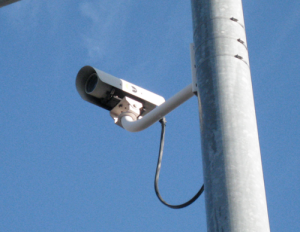
There is little controversy within the academic and scientific community that surveillance cameras don’t work, either to prevent or solve crimes.   City-wide surveillance cameras have been around since 1994, and in the last two decades there have been numerous studies on their effectiveness.  They show that it’s minimal at best.

The Studies:

England

Perhaps the most extensively studied camera system is also the biggest: England’s.  Put together, England and Wales have 4.2 million cameras and, not surprisingly, the British government was interested in finding out if they worked.  In 2002, the Home Office conducted a meta-analyses of the studies published until then and found that taken together the studies showed no reduction in crime.   While some of the studies analyzed did show a small reduction in crime, these were mostly on parking lots and cameras had been added in addition to other improvements (such as increased policing and lighting).   In the two cases where cameras alone were added, crime either didn’t change or actually increased.

The Home Office conducted another meta-analyses in 2005 with similar results.  Researchers found that only one out of 13 sites studies showed a statistically significant reduction in crime, and that fear of being victimized did not decrease either.

Cameras have also been of very limited use to solve crimes.  In 2009, British police complained that only about 3% of robberies were solved through cameras – a ratio of about one solved robbery per 1,000 cameras.  While they had many excuses as to why the cameras were not more effective in a country that is blanketed with cameras, the fact remains that Police were able to solve 97% of robbery cases through traditional police work.

San Francisco

San Francisco has recently acknowledged that its surveillance camera system is a waste.  A 2008 study showed that surveillance cameras were effective at reducing property crime within 100-feet of the camera only, beyond 100 feet they were useless.   Surveillance cameras were also effective in displacing violent crime to 250 feet away from the cameras.  The overall rate of violent crime did not decrease.

Los Angeles

A 2008 USC study showed that areas with surveillance cameras had the same reduction in crime rates as areas without them.

Philadelphia

Here, researchers did find a statistically significant reduction of crime of 13% overall in target areas where cameras had been placed.  However, most of that reduction was in disorderly, rather than serious crimes, and it was not uniform – in some areas there was no difference or displacement into nearby areas.

Washington DC, Baltimore and Chicago

Researchers at the Urban Institute conducted a study on the effect of surveillance cameras on those cities.  They apparently had written the conclusion before they actually looked at the data, because while they assert that surveillance cameras are a cost-effective crime deterrent, their data does not support that assertion.  They found that:

– In Washington DC, cameras did not have a deterrent effect at all.  They hypothesize that surveillance cameras don’t work at all unless they are monitored live.

– In Chicago, they evaluated two neighborhoods where cameras were installed and were under live monitoring.  The found that crime reduction in one one of the neighborhoods could be attributed to the surveillance cameras, but not in the other.  However, during the period of the study the neighborhood that saw decreases in crime attributed to cameras, also saw significant gentrification as well as police initiatives in surrounding areas.  It’s therefore questionable whether the crime reduction seen in the study can be attributed to the cameras.  Moreover, an ACLU paper shows that only 1% of arrests involved cases caught by the cameras, and there were no prosecutions.

– In Baltimore, researchers found that reduction in crime rates could be attributed to cameras in some neighborhoods but not in others.  This suggests that factors other than the surveillance cameras may be at play here as well.

Other Experiences

According to the Times Picayune: “In seven years, New Orleanscrime camera program has yielded six indictments: three for crimes caught on video and three for bribes and kickbacks a vendor is accused of paying a former city official to sell the cameras to City Hall.”

I wouldn’t be surprised if that would be the same fate of the surveillance camera project in San Leandro.

Sep 052013
 
Police Chief Sandra Spagnoli

Police Chief Sandra Spagnoli

But will the Council and City Manager let her get away with it?

Tuesday night, San Leandro Police Chief Sandra Spagnoli was caught lying to the San Leandro City Council several times.

Two lies are so blatant, that there can be now wiggle room around them.

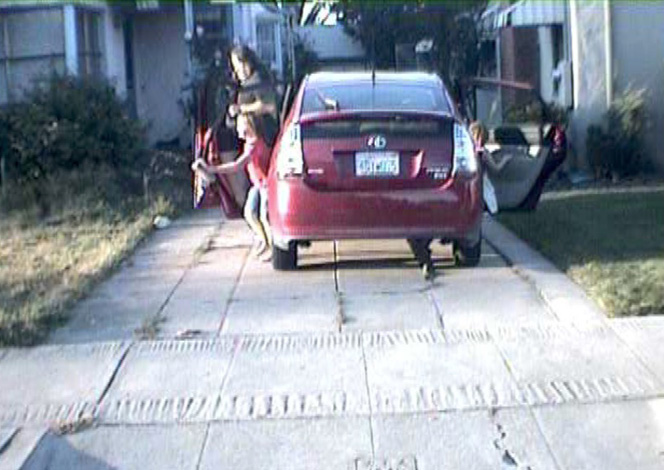
1 – She told the City Council that the SLPD only has one police car equipped with license plate scanners mounted on them.  But as Mike Katz-Lacabe, my husband pointed out, it has 3.  He’s taken pictures of them, in case there are any questions.

2- She told the Council that license plate scanners only get the “photo of the license plate”.  Again, a lie, as the license plate picture below shows.

Now, these are by no means the first lies the Chief tells the Council.  She’s lied about the effects of marijuana dispensary on crime and she lied about how long license plate information is kept for, for example.

And as Councilmember Jim Prola pointed out when I brought this matter up to him, last night she repeatedly tried to mislead the Council (Prola wouldn’t commit to using the word “lie”) when she claimed that license plate data had to be retained for a year because they are sharing it with the Northern California Regional Intelligence Center (everyone who drives in San Leandro is a suspected terrorist, it would seem).  Under questioning by Prola, the representative from the Center reluctantly admitted the Council could set whatever term in wanted for keeping the data.

And she’s lied directly to the community about things such as how realignment works.

But the thing about these two lies last night is that there is no room for ambiguity.  Either license scanners only take pictures of the license plates as she claims or they don’t, as the picture shows.  Either there is one car with a scanner or there are three, as the other photos we have show.

The City Council knows now without a shadow of a doubt the the Chief of Police has so little respect for them that she will lie and lie to their faces.  Meanwhile, she asks them to “trust her”.

Mayor Cassidy wanted to see one of the “audits” on the Police Department, done after an SLPD narcotics officer was convicted of selling drugs to an informer.  The Chief  denied him access to it, claiming it has sensitive information.   “You have to trust on your Chief of Police” she said.  But how can the Council – and the citizens of San Leandro – trust a Chief who has repeatedly been caught lying?

I don’t have much admiration four our City Council.  But do any of them have any self-respect?  They must know the Chief doesn’t have any for them – otherwise she wouldn’t lie – and yet they let her get away with this type of behavior.

I have a call to the office of City Manager Chris Zapata for comments.  Zapata is ultimately her boss.  Is she lying with his knowledge? His approval? Is she completely insubordinate?

I have also contacted the Mayor and City Council for comment.  I will update this article if I hear back.

Photo of my family, car and home taken by an SLPD license plate scanner and obtained through a CPRA request.