Mar 242012
 

Yesterday, a young woman was stabbed to death by her boyfriend near downtown San Leandro.  The stabbing was witnessed by a friend and the suspect was quickly caught.  Of course, that doesn’t do the victim any good.  Nor did the quick arrest of another man who also stabbed his 15-yo girlfriend to death earlier this year.

I congratulate the Police for their quick work, but I can’t but wonder if these murders demonstrate a much larger problem of domestic abuse that we are not seeing.  And behind that, a greater problem of men who are growing up without the coping techniques to deal with anger and frustration and know little else but to resort to violence.

Domestic abuse is not a police problem.  Washing our hands and looking at the police to arrest perpetrators is of little use.  At the moment you are hitting your wife or killing your girlfriend, you are not rational enough to be thinking “I better not do this or I’ll go to jail.”  This is a problem that we need to address earlier, from the moment a child enters kindergarten, and we must do it as a community.

I salute our public schools for having initiated the anti-bullying program at the elementary schools.  I know that at Roosevelt it works great, my daughters report that there is very little teasing going on, much less violence.  Things seem to be different at the Middle School and High School, and as the District is forced by a declining budget to cut counselors it will even get worse.

The City, of course, could very well step up. It could fund those counselors as well as early-intervention programs for children who are showing signs of anger problems and violence. It could institute outreach programs to victims of violence, direct them to existing services and so forth.  When he was running for election  Mayor Cassidy listed proudly his seat at the Board of Building Futures for Women and Children, a shelter for victims of domestic violence,  but what we need are programs, not just warm seats.

The City Council and the Mayor will cry that there is no money for social services such as these.  However, they have little trouble finding it to fund needless lawsuits and enriching their employees.   Just last Monday they approved a $500,000 parting gift for four staff members.  Right before I reminded them of their greater obligation to the community – but the vote was still 5 to 2 (with Cutter and Cassidy voting against it).

What we need in this town is leadership.  As a woman, I applaud the fact that four of our Council members are women and that three of our top-level City staff are as well.  But for years, women have been saying that if they were elected to office, if they had positions of responsibility, they would do things differently.  It’s time they follow with those promises.

Councilwomen Joyce Starosciak, Diana Souza, Ursula Reed and Pauline Cutter – show yourselves!  Get off your comfy chairs, take your lips off the butts of City staff (to be fair, this doesn’t apply to Cutter), and show that leadership.  Create programs to help the community, find the funding and don’t whine.  You were elected to do a job, do it!

And the same goes for Assistant City Manager Lianne Marshall and Deputy City Manager Jacqui Diaz.  Justify your six figure salaries!

Of course, leadership is not enough.  There has to be a commitment from the community to address the issue of domestic violence, but few things take place without someone taking that leadership.

Mar 192012
 

Stephen Cassidy describes himself a consumer attorney, but since he became Mayor of San Leandro he has spent more time breaking the law than arguing it in court.  I have written before – and I have written to him – about some of the numerous Brown Act violations that the San Leandro City Council has committed under his leadership.  Unfortunately, he doesn’t seem to have any plans to stop and indeed is now moving ahead into actions that the law considers misdemeanors.

At the last City Council meeting, Cassidy told Councilman Prola to ask John Chiang, the State Controller, to not force the City of San Leandro to return the properties it took from the Redevelopment Agency (RDA). Under the law that closed down the RDAs, Chiang must audit all the cities in California, and force those that engaged in those transfers, to give the properties back.  If the City hears from Chiang before it sells the former Albertson property to David Irmer, it won’t be able to do so without opening it up for bids from other developers who may pay more.

It’s a misdemeanor for any public official to willingly fail to perform their legal duties, and anyone who advise sand encourages the commission of a crime, is himself guilty of that crime.  It’s been a while since Mayor Cassidy finished law school, so he might not remember this, but he should at least realize that it’s unethical to ask Chiang to not do his job.

Cassidy is also set to commit another misdemeanor tonight.  On its face, it’s a minor matter.  The City Council will be considering in closed session whether they should file an  amicus curiae brief on the Arizona vs. United States litigation at the Supreme Court.   The State of Arizona passed a draconian immigration law a couple of years ago that empowered police to ascertain the immigration status of anyone they arrested, and kept people in jail until they were confirmed to be legal immigrants or citizens.  It’s not clear to me whether the City will side with Arizona or the US government, but it is clear to me that San Leandro is not a party to this litigation.  The Brown Act only allows the City Council to meet in closed session to discuss litigation to which it’s a party, and therefore the City Council, with Cassidy at its head, will be once again violating the Brown Act.

However, it’s likely that this time Cassidy et al will go beyond just violating the Act. While mere discussions of inappropriate matters in closed sessions do not impose much in the way of penalties on the City Council,  each City Council member “who attends a meeting of that legislative body where action is taken in violation of any provision of  [the Brown Act], and where the member intends to deprive the public of information to which the member knows or has reason to know the public is entitled under this chapter, is guilty of a misdemeanor.”.  In other words, if the City Council decides to take any action with respect to the amicus, whether to file it or not, those City Council members present will be guilty of a misdemeanor.  I have informed Mayor Cassidy et al about their obligations under the Brown Act, so any decisions they make to discuss this secretly will be done on purpose.

Now, I have no doubt that City Attorney Jane Williams has advised them that it’s OK for them to do whatever they want to do, that’s pretty much how she operates (thus the reason why the City keeps getting sued for millions of dollars), but they also have responsibilities as public officials to ask the right questions and think for themselves.  Cassidy is a smart and trained as a lawyer, so he definitely can do it.  As for the rest,  if they can’t, if all they can do is sheepishly do as they’re told, maybe they should find other jobs.  Ursula Reed and Jim Prola, who are both running for re-election this year, in particular should consider this alternative.

Finally, why commit criminal acts over something so silly? Sure, the chances of being prosecuted by the DA are probably pretty minimal (this time around, though surely the more complaints the DA gets about criminal violations, the more likely she’ll look into them), but still they do exist.  I can only imagine that two things are at play here:

1) The City Attorney just loves secrecy and does not want any legal matters whatsoever to be discussed openly.

2) If the City Council decides to file a brief on this case, it will be unpopular with many people.  Liberals and Latinos will cry out if the City sides with Arizona, while the old white voters (and their tea party offspring) will be up in arms if San Leandro sides with the US government.  I can imagine that they rather just not deal with this.

Of course, I also imagine that costs are at issue here as well.   Many amici briefs have been filed already, and I can’t imagine the City can come up with arguments not covered in any of those.  More likely, Meyers Nave is planning on its own amicus as a way to get paid more legal fees.  I wouldn’t be surprised if they were going with the same proposal to all of the cities they represent.

Mar 162012
 

I heard yesterday that Oakland City Council Member Ignacio De La Fuente wants to become Chair of the Alameda County Democratic Party.  Not only is he running for the Democratic Central Committee, but he has a slate of candidates running with him.  Among these are Claudia Burgos, one of his staffers, Mónica Tell, a former Perata staffer close to De La Fuente and Monique Rivera, whom De La Fuente endorsed when she ran for BART.  All of these are running for District 18, which includes San Leandro (and therefore they are running against me).  De La Fuente also has allies in District 15, including Frank J. Castro, communications director for Make Oakland Safe Now!.

As a current member of the Alameda County Democratic Central Committee, it’s hard for me to fathom why De La Fuente would want to be county party chair.  That is one of those completely thankless positions.  You have to do a lot of work, managing the committee, organizing fundraisers and events, running endorsements events, organizing meetings and keeping many diverse voices under rule.  And there is absolutely no power on the position.  Meetings are ran according to the Roberts Rules of Order – and the membership is vocal if they’re not followed to the letter.  Our current chair, Robin Torello, refrains from letting her political positions known and does not endorse individual candidates, so that she can remain above the fray.  I think the membership would expect the same of De La Fuente if he became Chair.

I don’t know Mr. De La Fuente, I haven’t noticed him coming to any of the meetings since I became a member, but I know he’s an astute politician and he may have an actual strategy under his belt.  Or he may just destroy the functioning of the Committee – which really needs an experienced manager to make it run functionally.  Indeed, if management was something Mr. De La Fuente was interested in, I’d urge him to spend a couple of years apprenticing under Torello and learning the job.

I’ve invited Mr. De La Fuente to comment here.


Mar 152012
 

Short Answer: No

There are many things that voters should look into when choosing which candidate to vote for, but endorsements from politicians, parties, organizations and even prominent individuals is not one of them.  The unfortunate fact is that most politicos and organizations do not endorse based on the quality of the candidate, but based on factors such as personal ties, political advantage, likelihood of winning and willingness to do their bidding.

For Voters: How Candidates get Endorsements

Incumbency/Likelihood of Winning

Endorsements usually go to the candidate deemed most likely to win, which is usually thought to be either the incumbent or the candidate that has raised the most money.   This is true for both individual and institutional endorsers.  Most endorsers want something in return for their endorsement (even if simply access or future support), and they’re more likely to get it if their endorsee wins.  In addition, some candidates have a reputation for vindictiveness, and politicos or organizations may not want to irate them by endorsing their rivals.

A couple of examples.  During the 2010 Mayoral election, the Police Union initially endorsed City Council member Joyce Starosciak.  Not only was she a staunch police supporter (her husband is a sheriff deputy), but the conventional wisdom back then was that a woman candidate, going against two males, would win.  As the campaign developed and it became clear that Starosciak wasn’t doing well, the Police Union hurried to co-endorse the incumbent Mayor Tony Santos (who had a reputation for vindictiveness).  During the 2008 campaign, the San Leandro Teachers Union (SLTA) endorsed Carmen Sullivan for School Board, but only after it was clear that she was the only candidate running.  Sullivan was at the time a supporter of Superintendent, which the SLTA wanted to oust.

Personal and Political Ties

It makes sense, if a candidate is your friend you are likely to endorse him.  Some ties are very old and very strong.  For example, Congressman Pete Stark had a standing policy of not endorsing candidates in non-partisan races when more than one Democrat was running.  However, he broke his rule and endorsed Julian Polvorosa, a long time friend,  for City Council during the 2006 race.  Charlie Gilcrest, a local campaign manager who has been active in the Democratic party for close to forty years, obtained the endorsement of practically every politician in the East Bay when he ran for City Council in 2008, even though he’d never held elective office.

There is also an unwritten rule that if someone works in your campaign, you endorse them when they run for office.  For example, Governor and former Oakland Mayor Jerry Brown recently endorsed Libby Schaaf for Mayor; she used to work for him.

Not everyone follows this rule. Ellen Corbett, in particular, is much criticized for putting political considerations above loyalty to her former supporters. That strategy came back to hurt her, however, when she ran against Eric Swalwell for Congress.  Most of those former supporters turned on her.  They knew she wouldn’t have their back.   Smart candidates, however, pay their political debts.

Political Alliances

Often times endorsements are the result of political alliances.  An endorser who doesn’t care much about the outcome of a given race, might endorse a candidate at the request of a political ally or, in case of politicians, big campaign contributors that do have a steak in that race.

Affinity Politics

African American politicos almost always back other African Americans.  This is less true for Latino and Asian politicos.  It makes sense.  As minorities, you want to build the influence of your community in the political arena.  The problem is that the candidates they back are not always going to be the best.

Similar Agenda

Organizations, in particular, are likely to endorse candidates who have similar agendas (or views) to their own.  This can be a good or bad thing, as far as voters are concerned, depending on whether they know what the actual agenda of the organization in question is.  For example, the SLTA backed Hermy Almonte and Morgan Mack-Rose in the 2008 School Board election, because they also wanted to get rid of the Superintendent.

Some membership nonprofit organizations, however, have been “infiltrated” by members who are more interesting in political power than furthering the cause. Endorsements from the Sierra Club, for example, are often suspect.

Tit-for-Tat

Business associations, in particular, are likely to endorse candidates based on what they think the candidates can do for them.  The Rental Housing Association and the Association of Realtors, for example, will endorse candidates that will vote against rent control measures. The Chamber of Commerce will likely endorse candidates that won’t vote to raise the minimum wage.  The Police and Fireman unions will endorse candidates that are willing to give their departments the most money, raise their salaries and pensions, and do not insist in holding their departments accountable.

Pettiness

Often times, endorsements are actually based on pettiness.  In 2010 the SLTA endorsed Corina Lopez for San Leandro City Council – even though they had never before endorsed in City Council races – because she was running against Pauline Cutter, whom they opposed because she had supported the Superintendent they didn’t like.  In 2012, the SLTA president endorsed Ursula Reed because she was running against Morgan Mack-Rose whom, as School Board president, had angered the SLTA leadership.  In the current election, Diana Prola endorsed Leo Sheridan, and worked hard to get him the endorsement of the Democratic party and of labor, because he’s running against Latrina Dumas.  Dumas was a parent supporter of that controversial Superintendent and often spoke out in her favor at School Board meetings.

Democratic Party

The candidates endorsed by the Alameda County Democratic Central Committee are often those that have powerful interests behind them.  Candidates often hire Alliance Campaign Strategies, a campaign management firm run by a member of the ACDCC’s executive committee, as a way of assuring themselves the Democratic endorsement or at least blocking that of their opponents. There is a lot of behind the scene deal making and threats.  Occasionally, the endorsements do go to the candidates that best exemplify Democratic values, but often that’s not the case.

The Democratic endorsement is considered very valuable, however.

Newspapers

A newspaper’s endorsement will be based on the political views of their current editorial board. In the case of the Bay Area Newsgroup papers (Oakland Tribune, Daily Review, etc.) their endorsement is based solely on how much a candidate knows about the financial situation of the city/district they are running for, how much they understand the nature of their unfunded liabilities and how they plan to address this issue.

Whose endorsement should you actually pay attention to?

My own, of course.  I’m sort of joking, but I do actually stand by the candidates I endorse, whom I’ve chosen based on their liberal ideology, knowledge base and ability to do the job.

The endorsements you really should pay attention to are those of people you know and respect, who know the candidates and, preferably, the requirements of the office for which they are running.  For example, I decided to vote for Latrina Dumas for San Leandro School Board in part due to the fact that a friend of mine, who has been involved in the schools for many years and understands what the School Board does, fully recommended her.  Sure, I did my research, but her first-hand opinion mattered greatly.

Beyond that, pay attention to endorsements that actually explain why a candidate is chosen over another.  The Green Party, for example, provides explanations of their endorsements, though unfortunately they don’t include San Leandro.  The East Bay Express and other newspapers do as well.

For Candidates: Which endorsements should you seek?

You should seek endorsements from organizations or people:

1- who will give your campaign financial contributions

2- who will get others to contribute to your campaigns or throw fundraisers for you

3- who will put elbow grease into your campaign

4 – who have a “base”.

One of the reasons why labor is so powerful in the Democratic party is that they can do all of those things for you.  While you can definitely win against a candidate endorsed by labor (Mayor Cassidy did in 2010 and Benny Lee in 2012), it’s definitely easier if they are behind you.

An endorsement from the Democratic Party, on the other hand, is much less powerful because it’s “passive,” i.e. it doesn’t come with anything attached.

In addition to the unions, there are several PACs that will give you campaign contributions, often considerable ones.  They usually won’t do anything more than that for you, but money is essential for running campaigns.  Of course, most of those PACs will want something from you in return.

Having big politicians endorse you is usually, in itself, not that useful – it may help your ego, but voters are seldom  impressed -, unless those politicians also contribute to your campaign directly or indirectly.  Mayor Cassidy, for example, gave Pauline Cutter’s Mayoral campaign $2,000 and has helped her campaign behind the scenes.   Other politicos, on the other hand, usually do little more than sign their names and, if you are lucky, record a robocall for you.  If you are running, it’d behoove you to find out which endorsements are worth pursuing.

The value of big-name endorsements, however, is in convincing other endorsers that you’re the most credible candidate, and thus generate the support of more endorsers, in particular those who will give you money because they believe you’ll win.

For local campaigns, volunteers are just as important as money, if not more so – so pursuing the endorsement of people and groups that are willing to put time and effort into your campaign is time well spent.  For example, the San Leandro Community Network, a now defunct local political and civics organization, did not make financial contributions to political candidates, but its members provided lots of very valuable volunteer work, from graphic design to data management and computer services, to phone banking, walking and flyering.  The candidates they supported saved thousands of dollars (tens of thousands, in the case of Cassidy) by having SLCAN members work on their behalf.  Similarly, in San Leandro you want to get Jim Prola’s endorsement (though he’ll rarely endorse someone until Labor endorses them first), because he LOVES walking door to door and he’s great at convincing people to vote for you and put up a lawn sign.

Finally, you want the endorsement of people who have influence among the voting population you are targeting.  Some times those people are politicians, but most often they are not. In general, the higher up the ladder the politician is, the less influence s/he has with the voters – at least for what I can see.  Stark’s endorsement did little to help Polvorosa, Corbett couldn’t help Santos and Hayashi didn’t help Starosciak.  That’s because people who are in Washington or Sacramento most of the time, are unlikely to be able to keep their bases energized and loyal.  But you can’t even count on local politicians to have bases – they need to be built, and that requires a lot of time and effort.  Currently, in San Leandro, I’d say there are only a couple of politicians that actually have influence over a large number of voters.

Non-politicians can actually be more influential.  Go after people who are thought to be “on the know” and reasonable by many members of the community.  Long-time teachers, coaches and principals are great endorsers, as hundreds if not thousands of voters may have personal experiences with them (just make sure the teachers were well thought of).  Endorsements by community leaders are great as well.  Religious ministers can endorse you in their personal capacity – so it’s not a bad idea to seek the endorsement of those who have particularly large congregations.

Some endorsements from well known people are more problematic.  My endorsement, for example, may lose you as many votes as it gains you.  The same can be true of PTA and Homeowner Association presidents – often times there are as many people who dislike them as who like them.

How to get the endorsements you want

Organizations, such as the Alameda Labor Council and the Democratic Party, usually have procedures for getting their endorsement and you should look them up on their website.  As for the rest, you need to call – and ask to meet with them.  And then you sell yourself to them.  To do so, you need to be prepared.  You need to know why you are running, how your values match theirs, what your position is or would be in a number of different issues, and how you differ from your opponents.  Cold calling is fine, but it’s best if you can have someone with influence with them call for you first, or at least let you use their name when you call (i.e. “I’m running for X, so-and-so suggested I meet with you).

Now, as I mentioned above, some endorsements are very political and a simple meeting won’t do it.  For those, try to find someone in the know to give you some hints on how to approach them.

If you have any questions or comments, feel free to contact me.

SLT’s Guide to Local Elections

This article was updated for the Nov. 2014 election.

Mar 122012
 

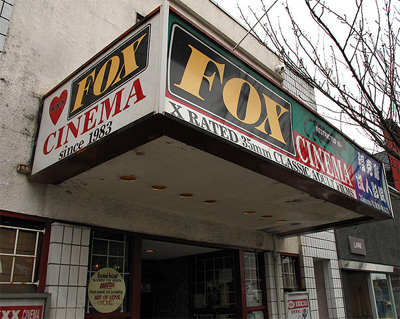
The Fox Cinema in Vancouver shows adult movies all day long.

Proposed Amendments to the Zoning Code would ban recreation and entertainment from the industrial area – but would allow “adult businesses” to continue.

Ban likely to be unconstitutional and won’t help with the Faith Fellowship lawsuit.

If Meyers Nave, the law firm that represents the City of San Leandro, gets its way, strip bars and peep shows could flourish in the industrial area of San Leandro.  But theaters, cinemas and recreational venues would not be welcomed.  Shakespeare would be OK, but only if all the actors were nude and got frisky with one another.

At its next meeting, the City Council will again consider banning entertainment and recreational uses from the industrial area of town.  This short-sighted plan was concocted by Meyers Nave  in response to the Faith Fellowship litigation.  Currently, the Zoning code allows entertainment and recreational uses of properties zoned industrial, but not assembly or religious uses.  The 9th Circuit recently ruled that such unequal treatment violates RLUIPA.

The City has potentially two ways in which to amend the code to comply with federal law.  It can either allow religious/assembly uses in the industrial area or it can ban entertainment and recreational uses.  The former approach can contribute to the development of the industrial area, it can bring new people to San Leandro – who will then be likely to shop and dine in this city -, and it can create competition for the purchase of properties, bringing up property values.

The City Council, however, has chosen to focus on the second option: banning entertainment and recreational uses in the industrial area.  I have written before as to why this is a bad idea: the high-tech companies we want to attract realize the importance of combining entertainment and recreation with work – it makes for happier, more productive employees.  Indeed, this is a point that David Johnson, CEO of the San Leandro Chamber of Commerce, has repeatedly made to the City.  Johnson spent a decade working on economic development in Oakland and knows first hand how companies seek to move to cities that don’t make them jump through hoops.  When presented with these facts, the Planning Commission voted twice to reject the entertainment and recreation bans.

The City’s attorneys, however, are adamant about further restricting uses in the industrial area, and they hold a lot of sway with the City Council.  At the last Council meeting, Deborah Fox admitted that the only reason to amend the code was to facilitate the city’s legal strategy on the Faith Fellowship case.  She stated that the district judge will consider the Zoning code as it stands when trial begins, and thus there is a hurry to make these changes soon.

I am unable, however, to figure out what advantage Fox thinks the City will gain by making these changes.  Leaving the issue of adult entertainment aside, the proposed changes in the Zoning code would likely prevent the Church from obtaining a declaratory judgment to the effect that the City’s Zoning code violates RLUIPA.  The district court, however, would still have to decide whether the City violated the equal terms clause of RLUIPA back when it stopped FF from moving into the property they’d bought, and if so, award monetary damages to the Church.  The only “advantage” I can see for the City is in being able to stop Faith Fellowship from acquiring another property in the industrial section and putting a church there.  This may seem very petty, but the City Attorney may have been able to sell this approach to the Council as some sort of “victory”.

In any case, their strategy is very unlikely to work. The Zoning code amendments will bar entertainment and recreational uses from the industrial area, but will continue to allow adult businesses, including adult entertainment businesses, to operate.  The City doesn’t have much of a choice about this, it must allow such businesses to locate somewhere in town and the industrial area seemed the most unobjectionable one when the code was last amended.  But this means that in order to ban adult entertainment in the industrial area, the City must first allow it elsewhere within City limits.  That would open a whole new can of worms that the City, of course, wants to avoid.

But if the Zoning code isn’t changed to disallow adult entertainment in the industrial area, the City is in exactly the same position that it is today: treating churches differently than entertainment venues, and that’s what the 9th circuit has said they cannot do.

As if this wasn’t enough, it seems quite likely that the City doesn’t have the right to ban entertainment from the industrial area in the first place.  Entertainment is considered a form speech and therefore protected by the first amendment.  In Schad v. Mount Ephraim, the US Supreme Court ruled that any ban on entertainment must be “narrowly drawn and must further a sufficiently substantial government interest”.    Schad concerned a city ordinance which prohibited live entertainment in the commercial district, while allowing businesses such as motels, lumber stores, restaurants and office buildings.  In that case, the Court could not find any “substantial government interest” accomplished by the ban.  But a Court looking at an entertainment ban in San Leandro would not even have to look that far – Deborah Fox is on record saying that the only reason for the ban was to gain an advantage in their litigation against Faith Fellowship.  No Court in the land will consider that to be a legitimate, much less a “substantial,”  reason for restricting speech.

We are left with the question, then, of what the City’s attorneys reasons for pushing these changes are.  As I’m not a mind reader, I can only speculate:

Incompetence.  Meyers Nave handled this case badly from the start, neglecting to tell the Council about the risks and potential costs of stopping FF from building their church.   Deborah Fox, in particular, did a horrendous job of arguing the case before the 9th circuit; she seemed surprised by the questions posed by the judges and had no answers.  Her whole handling of the situation since does not inspire confidence in her legal acumen.  So it may simply be that Meyers Nave didn’t look carefully enough at the Zoning code or the law to actually understand the issues at play.

Presumed incompetence.   Meyers Nave tried very hard to have the amendments to the Zoning code be made as quietly as possible.  City staff made up reasons for why these changes were needed, they hid the actual nature of the changes, and the City Council was only informed about them in closed session – very likely in violation of the Brown Act.   They probably believed that they could sneak them by without Faith Fellowship’s attorneys noticing.  I wouldn’t be surprised if Meyers Nave is also hoping that FF’s lawyers won’t re-read the Zoning code and notice that the “adult-oriented businesses” clause will remain in place.

Profit.  The City pays Meyers Nave a very generous amount for general City Attorney services, but they must pay them by the hour for any litigation services.  This means that the more bad advice Meyers Nave gives the city, the more likely the city is to get sued, and the more money Meyers Nave will make in attorney’s fees.  Smart cities avoid this clear conflict of interest by having the City Attorney be an employee, and thus not personally benefit from any litigation.

So what now? We can hope that the City Council will see reason, and will realize that what’s best for Meyers Nave is not what’s best for the City.  We can ask that they do what they were elected to do and include the citizens in any and all decisions that will have such a great impact in the community.  And we can urge them to let get independent legal advise on this matter – from a firm not hired or recommended by Meyers Nave.

Unfortunately, I’m not too hopeful.