Margarita Lacabe

May 192014
 

May 19, 2014

Grover Norquist
Americans for Tax Reform
722 12th Street, NW
Suite 400
Washington, D.C. 20005

Dear Mr. Norquist,

I’m very concerned that our political philosophies may be starting to merge.

I commend you on wanting to name three thousand items in the country after Ronald Reagan. As you know, I was in the state legislature when Ronald was governor and I fondly remember his signing the largest tax increase in the more than hundred year history of our state. That Reagan tax increase stood as the state’s largest until of course the early 1990s, when Governor Pete Wilson signed a $7.3 billion dollar tax increase.

I also fondly remember Governor Reagan signing the bill to liberalize abortion, the Therapeutic Abortion Act.

I think it’s wonderful that you’re willing to honor somebody who has such a liberal progressive record.

Peace and friendship,


John Burton
Chairman
California Democratic Party

May 132014
 

Video release of California Senate candidate’s shoplifting raises questions about ethics and privacy

Note: This article has been updated since it was first published.
maryface

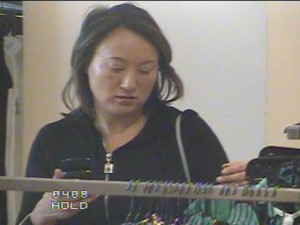
The woman absently browsing through the racks of clothing that afternoon at Neiman Marcus looked haggard. Her dyed hair appeared uncombed and unwashed, her usually perfectly made-up face was bare and she was wearing a less-than-flattering jogging suit. As she shopped, she was encumbered by a large purse, a shopping bag from Nordstrom’s and another from Neiman Marcus. Her movements between the racks seemed random. Once in a while, she’d select a piece of clothing or two and hand them over to a saleswoman to take to the dressing room. Sometimes she would look at her phone. To the casual observer, she looked like a tired housewife trying to kill time. None of the other shoppers that afternoon seemed to have paid her any attention.

Assemblymember Mary Hayashi, however, had caught the eye of the security team at Neiman Marcus. A dress had disappeared the previous week after a woman matching her description tried it on. For an hour, the store’s high definition cameras followed Mary’s every move, zooming in on her face, bags and even the screen of her phone. Meanwhile, loss prevention agents in white t-shirts followed her discreetly on the floor.
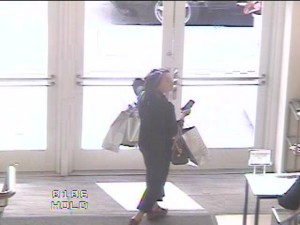
leavingIt was one of the loss prevention agents who watched Mary through the slats of her dressing room door, installed backwards for such purpose, and allegedly observed her dropping a pair of leather pants, a leather skirt and a white shirt into one of her shopping bags. The cameras did record Mary later, at the counter, purchasing a gold shirt and a pair of red pants, while returning some items of clothing she retrieved from her Neiman Marcus bag, for which she had a receipt. Mary chatted with the saleswoman, glanced at her phone and just lingered while waiting for her purchase to be rang up and packaged. If she was distracted, it wasn’t by a phone call.
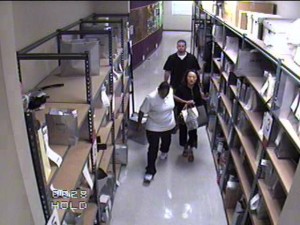
marysupplyWe see* Mary making her way out of Neiman Marcus with her three shopping bags on tow. We see* her being stopped just outside the store, and brought back inside to have her bags searched. She does not dispute that she had not paid for the leather pants, skirt and shirt that the loss prevention agents found inside one of her bags, with a total value of $2445. She pled no contest to shoplifting, an offense which has the intent to steal as one of its key elements (i.e. you cannot shoplift without meaning to). She has, however, consistently claimed she did not intend to shoplift.

***

Like many other observers of local politics, I was titillated when news broke of Mary Hayashi’s shoplifting arrest. I had supported Mary when she first ran for Assembly, and I was a novice about local politics, but had grown disenchanted by her “pay to play” approach to politics. There was something deliciously ironic about her being caught stealing at a high-priced department store.

As I knew very little about shoplifting, I decided to school myself on the subject before starting to thrown any stones. Fortunately, there are plenty of books, websites, studies and law cases on the topic. I learned, for instance, that “it was Neiman Marcus policy not to stop a suspected shoplifter unless a loss prevention officer actually observes the suspect removing the item in question from the rack and continuous surveillance is maintained,” so that any evidence against Mary Hayashi was likely to be rock solid. But I also learned that shoplifting is a psychological disorder which afflicts as many as 10% of Americans. While a tiny percentage of shoplifters do so for profit, the vast majority do it to fulfill psychological needs, to fill an emptiness inside or get a high from getting away with the theft. About a third of shoplifters report having been diagnosed with depression. Shoplifting can quickly become addictive, specially as the chances of getting caught are low: shoplifters report being caught about once for every 48 times they steal. Treatment, meanwhile, is very difficult, though a drug used to treat alcoholism shows promise.

Before becoming a member of the California Assembly, Mary Hayashi was a mental health advocate for Asian women. She wrote in her book Far from Home how her passion came from her experience with her own sister’s suicide. It seemed likely that Mary’s shoplifting was based on emotional rather than (at least exclusively) economic needs. Her arrest was a perfect opportunity for Mary to confront her own mental health issues, and in doing so, bring attention to a disorder that afflicts many people from all sorts of lives.

Instead, Mary coped out. Though she plead no contest, basically admitting her guilt, she continued making excuses, claiming she was distracted and later insinuating that a benign tumor she was suffering from, might have played a role in her actions. The latter may actually be believable. Studies have shown that damage to some areas of the brain can interfere with decision making processes, including kleptomania. Mary did not press the issue, however, as admitting faulty decision-making abilities can be a problem for a politician who wants to remain viable. Still, her inability or unwillingness to come clean about her mental health issues – issues to which she had previously dedicated her life -, seem contemptible to me.

***

Mary Hayashi, now, is running for state Senate. She has a very large campaign chest and no scruples. Perhaps that, too, is a consequence of her brain tumor. She has attacked her opponent mercilessly, suggesting that he supports rapists because he voted against an early version of a bill that took away judicial discretion on division of assets after a divorce. She should not be in Sacramento. That is half of the story.

The other half is the issuagente of privacy, surveillance cameras and see-through dressing room doors. The latter matter is, perhaps, the most blatantly obnoxious. Many people are modest and don’t want to be seen naked by others – be they store employees or anyone else walking by. That’s why dressing rooms exists in the first place. While in this case the loss prevention agent actually caught Mary hiding store merchandise, it’s likely that in many cases they observe completely innocent people in their underwear. I think that at the very least consumers should be informed that they can be seen while changing with the doors closed.
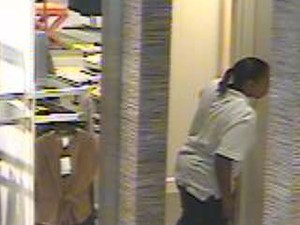
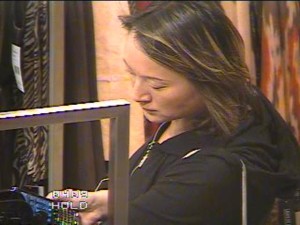
zoominThe surveillance issue is also troubling. Mary was in a store and she probably knew that there were cameras. I doubt, however, that most consumers realize just how intrusive these cameras can be. Shoppers are unlikely to be aware that a camera mounted on the other side of the room can zoom on their faces so precisely that someone could read their lips and eavesdrop into private conversations. They are probably not aware that the cameras can also zoom onto the screens of any papers or screens they have with them, potentially recording private information. A shopper who sees a person looking at what they are holding or studying their mouth movements, would probably walk away; cameras do so undetected.

More and more municipalities are putting cameras like these on public spaces, again without notifying citizens of how much information about their every day lives they can record. Surely sometimes – like in this case – they are useful (though it’s telling that none of the actual elements of the crime of shoplifting were recorded), but it is important for the public and lawmakers to also be aware of the negative uses of surveillance technologies.

Mary Hayashi’s arrest did not lead to the conversation on mental illness I wanted. I hope that the release of the video of her shoplifting incident will lead to a public discussion on the needs of surveillance versus privacy.

Full Shoplifting Trip Video


Mary Leaves the Stores and Gets Arrested

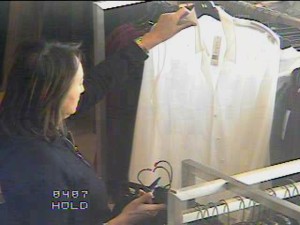
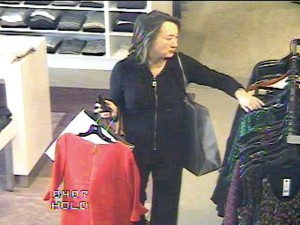
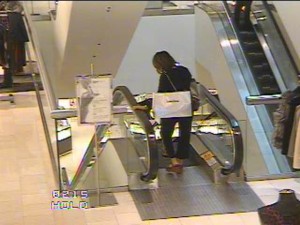
Some Stills from the Video:
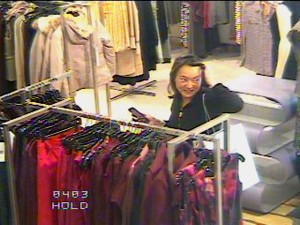
shopping1whiteblouseshopping2gettingpurchaseelevatorwatchingherutconfrontedsupply2

* An earlier version of this article said that we didn’t see Mary after she left the counter. That’s because I had only watched one of the two surveillance videos provided by the SFPD. The second video shows her exiting the store, being detained and being brought back into the store.  Stills from the surveillance video have also been added.

May 082014
 
This is an old picture. Mike's pony tail is even longer and more luscious now!

This is an old picture. Mike’s pony tail is even longer and more luscious now!

It’s that time again, the Roosevelt Elementary Spring Auction.  And after three years of growing his hair out, San Leandro School Board member and husband of mine Mike Katz-Lacabe is ready to have YOU cut it off.  All you have to do is have the highest bid at the silent auction.  If you are present, scissors will be provided and you can do the honors that very night, in the presence of EVERYONE.  You can cut the tail off and give Mike the dorkiest hair cut ever.  Bring your camera!

You can participate in this momentous occasion even if you’re not present. Just e-mail me and tell me how much you want to bid, and I’ll make a proxy bid for you. You can then cut Mike’s hair whenever you want.   And you can do whatever you want with the hair, donate it or have your own extensions/wig made out of it. It’s really beautiful, luscious hair.

Love or hate Mike, how can you pass up this opportunity? And the money all goes to a good cause – improving the education of Roosevelt Elementary students.

Roosevelt Elementary School Annual Auction & Roundup
Saturday, May 10
5 to 10 p.m.
Veteran’s Hall, 11105 Bancroft Ave., San Leandro

Tickets: $30 at the door

May 042014
 
Mayor Stephen Cassidy

Mayor Stephen Cassidy

San Leandro Mayor Stephen Cassidy announced today that he will not be seeking re-election for a second term as Mayor.  The news are unexpected, Cassidy had launched his re-election campaign with a kickoff fundraiser on St. Patrick’s day of this year.  Cassidy cites the difficulties of campaigning while also working full time, raising a family and performing his duties as Mayor.    Cassidy had no declared challengers at the time of his announcement.

Cassidy’s exit from the race leaves the field wide open for anyone who may want to run for the office.  With six months to go before the election, the biggest challenges will be fundraising and creating name recognition.

Two candidates are already likely to enter the scene.  Council member Diana Souza had long made the rounds trying to garner support for a campaign.  She hadn’t been very successful, but with Cassidy out of the way she has a shot.  Souza, however, was one of the candidates who voted to raise the Chinese flag over San Leandro City Hall, a very unpopular move with voters. She has, otherwise, a non-existent record of accomplishments.

Dan Dillman, the owner of the Historic Bal Theater, has also indicated he might run for this office.  Dillman ran for the District 2 City Council race in 2012, and commanded a respectful 25% of the vote despite virtually no campaigning.

Cassidy’s exit from the raise reinforces the urgency of turning the Mayor’s job into a full-time position with a corresponding salary.  It is very difficult for any person who has a full-time job and is raising a family to also successfully fulfill the responsibilities as Mayor.   And yet, some of the most competent and qualified candidates are exactly in that position.  I hope whoever is elected moves the city in that direction.

Mayor Stephen Cassidy’s statement

Dear Friends and Neighbors:

I have concluded it is in the best interests of our city and my family that I focus on serving as Mayor for the remainder of my term, which expires at the end of the year.

When I originally ran for office, I did not have the responsibility of governing. I have come to the realization that adding campaigning to my list of duties would mean the compromise of too many important existing responsibilities. I wish this was the not case. But I see no way I can meet my obligations as Mayor at a high level, as well as my work duties and be present for my young daughters, while also running a vigorous campaign for re-election.

I am proud of the renaissance that is occurring in San Leandro. The San Francisco Business Times recently reported that our city is “buzzing with a fresh technology focus.” In five weeks, the state-of-the-art San Leandro Kaiser hospital will open. Last month, the City Council unanimously approved construction of a commercial district for tech firms and other companies at the forefront of today’s innovation economy. Three, Class A office buildings will be built on the vacant lot next to the San Leandro BART station, creating nearly 2,000 quality jobs.

Much more can be accomplished this year. Again, I will complete my term as Mayor.

I look forward to working with the community and my colleagues on the City Council to place a revenue measure on the November ballot to repair our deteriorating neighborhood streets, create a commission of residents to foster and support the arts and culture in our city, and extend Lit San Leandro, our ultra high speed broadband network, to our schools.

It has been a privilege to serve you and the people of San Leandro as Mayor, and previously as a school board trustee. Thank you for enabling me to have such honors.

After my term as Mayor end on December 31, 2014, I will remain active in our community. I love San Leandro and look forward to continuing to make a positive difference for our city.

Stephen


Apr 162014
 

Will Technology Facilitate Direct Democracy?

Congressman Eric Swalwell’s proposal that Congress create an application to allow Members to vote remotely opens an interesting possibility.  There are two primary reasons for having a representative democracy.  One is practicality.  The type of direct democracy practiced in Greece required that citizens meet in person to cast votes.  This was difficult for those who lived in the countryside. Even for urban citizens, it was a cumbersome duty and enough citizens did not show up to vote that Athens had to experiment with inducements and punishments to get people to do it.

The second reason is the understanding that not every citizen can be an expert on every issue. Professional politicians,  on the other hand, can be expected to put their time and effort into carefully researching and deliberating each issue that comes before them.  Deliberation requires, of course, the exchange of ideas with others.

But if Congress members can participate in hearings and vote remotely, then so can ordinary citizens. If the application is secure enough to assure that a vote belongs to a Congress member (which I doubt it can be, given that the NSA seems to have complete control of our technology), then surely it is for the latter as well.  The practical need for a representative democracy is gone.

The knowledge need remains, at least theoretically.    But do Congress members actually vote based on the knowledge and careful deliberations we expect of them?  A look at Swalwell‘s own record suggests otherwise.   Since he was elected in 2012, he has spent most of his time campaigning.  He comes to the district almost every weekend so he can meet with constituents/voters.  Remote voting will help him to spend more time doing so.  As for voting, Swalwell, who was named an assistant minority whip, pretty much votes as he’s told to by the party leadership.  Only once or twice did he cast a vote different than Nancy Pelosi.  Surely citizens who want to vote as they’re told by their party, can do so just as well.

The question then becomes, do we really need Congress? If members are not meeting and deliberating, why have one person press the “vote” button in representation of many, rather than have the many do it for themselves?  Perhaps it’s this realization that has made Swalwell’s MOBILE proposal so unpopular among his Congressional colleagues.

While instituting direct vote-by-app democracy would require a constitutional amendment, and thus is unlikely to happen very quickly, there is no reason why states cannot start experimenting with it.   Given the corruption at the halls of our legislatures, it may not be that bad of an idea.