Margarita Lacabe

Feb 122013
 
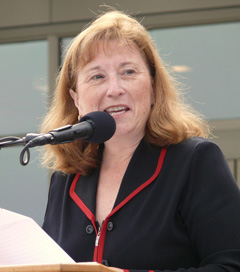
Ellen Corbett

Ellen Corbett

She can, but only if she stop playing it safe.

Last October, in the midst of the 2012 electoral battle between veteran Congressman Pete Stark and Dublin City Councilman Eric Swalwell for Congressional District 15, California Senate Majority leader Ellen Corbett took the unprecedented step of announcing she would run for that seat in 2014.

Corbett had been angling to run for Stark’s seat, after he retired, for years.  And there was much speculation that Stark would retire in 2012.  He was in his 80’s, frequently in bad health, and had been marginalized in Washington.  Furthermore, his district had been redrawn and he had lost much of the more liberal parts of western Alameda county, while gaining the conservative Tri-Valley area where his liberal policies were unlikely to be popular. Corbett already represented some of these areas – namely Castro Valley and Pleasanton – and her more moderate Democratic views would be an easier sell.

Stark, however, declined to do the “right thing” (for the local party, at least) and retire and while Corbett entertained the idea of challenging him, she eventually backed off. My guess is that labor would not support her against the aging incumbent.

Eric Swalwell

Eric Swalwell

Her decision proved to be like manna from heaven for Eric Swalwell.  The young Dublin City Council member had little to lose by taking on Stark.  A prosecutor from a conservative Bay Area suburb, Swalwell was too young and had yet to pay enough dues to be taken seriously by the Democratic establishment or by labor.  He had no support to lose by challenging the incumbent.

Swalwell, however,  proved to be a consummate campaigner, willing to knock on door after door, attend event after event, and embrace the power of social media and new campaign technologies. He was also able to draw on the expertise of local politicos disaffected with Stark and the local Democratic party. Our own Mayor Stephen Cassidy, for example, shared his own tips and experience on defeating incumbents (he’d done it twice in San Leandro) while Swalwell’s former High School teacher and mentor Dublin Mayor Tim Sbranti, an upcoming political force himself, once again took him under his wing. It certainly didn’t hurt that Stark made some serious gaffes during early debates and then disappeared altogether from the campaign trail, leaving it all in the hands of his campaign managers and his supporters in labor and the Democratic party.
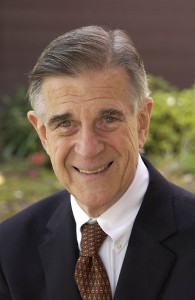
Pete Stark

Pete Stark

Ultimately, it was the new open-primary system in California that gave Swalwell his win. After his surprisingly good showing in June, which put him in a one-to-one contest with Stark in November, Swalwell started drawing on support and money from more disaffected politicians and individuals. He became the new darling of the news media, which covered Stark’s gaffes with gusto. And he was able to make the race about personalities, rather than issues, which allowed him the flexibility of appealing to voters with very diverse ideologies.

By the end of the campaign, Swalwell had raised $826K and spent $800K of that. That still pales in comparison with the almost $1.4M Stark spent on this race, but it definitely made him competitive.

At the end of the day, in the November election, Stark’s incumbency held and he easily won the part of the district that he had historically represented, while Swalwell easily won the rest.

The question, of course, is what all of this means for Ellen Corbett. While nobody can predict the future, it’s helpful to look at the differences between Corbett and Stark and what she can and cannot bring to a Congressional campaign.   Let’s also keep in mind that as everyone wants to back a winner, Corbett’s chances at winning are also dependent on the analysis politicos, contributors and voters make of those same chances. If people think Corbett has a shot, they are more likely to give her their support. And she will definitely need lots of it.

Ellen Corbett is not Pete Stark – in either the bad or the good ways. She is a calm, measured politician; she’s pleasant, smart, compassionate and empathetic, without being overly emotional. She is unlikely to make offensive statements on the campaign trail and give Swalwell the type of ammunition that he had with Stark.  However, Corbett has been in public office for a couple of decades: first as a City Council member and Mayor of San Leandro, and then in the California Assembly and now California Senate. If Swalwell decides to run a negative campaign against her, he will probably be able to find plenty of things to criticize.

In 2012, Corbett’s advantages over Pete Stark were that her Senate district included most of CD 15 and that her views were more moderate, and thus more attuned to the voters.   She’s always been a grass-roots politician, and knows the importance of one-to-one contact with voters. Voters have seen her at community events in their cities throughout the years. Since the district was redrawn, Corbett has also been seen in community events in those cities she does not currently represent: Dublin, San Ramon and Livermore.

In order to win, Corbett will have to make sure that the votes that went to Stark in 2010 now go to her and that the Democratic voters in Castro Valley and Pleasanton who voted for Swalwell, now vote for her instead. Of course, she will also have to make inroads with other Tri-Valley voters.

The first proposition should be the easiest. Southern Alameda county voters are used to seeing her name on their ballot and seeing her at events, and they may still be bitter about Stark’s loss. However, Swalwell is well aware of this and he is reaching out towards those parts of the district, attending events and trying to ingratiate himself with the local political establishment.  He might have made a mistake by locating his district office in Pleasanton, however, as that sends a message that his heart is really in the Tri-Valley (plus it’s awfully inconvenient for voters in the southern part of the district to drive to Pleasanton), but Corbett is not helping herself either by keeping her district office in San Leandro.

Converting Swalwell voters to her is likely to be more difficult. While it’s true that many of the votes that Swalwell got were “anyone but Stark” votes, Corbett will need to make a case to the voters as to why she’s a better choice for them than the man they just put in office.   Attacking his youth or inexperience did not work for Stark, so she will have to try to draw other distinctions.

So far the only message I’ve heard concerns Swalwell’s political stances. Rumors are being circulated that he has reached out to Blue Dog Democrats and to Republicans and that he is really a Republican in disguise (though that can also be said about President Obama).  But rumors are just rumors and Swalwell is smart enough to know that it behooves him, at this point, to entrench himself within the Democratic party and follow  Nancy Pelosi‘s lead.  So far, all indications are that he’s doing just that.  He has co-sponsored gun control legislation and the reauthorization of the Violence Against Women Act and he happily accepted being appointed an Assistant Whip, which means he is now responsible for making other Congress members fall into the Democratic party line.  If Corbett wants to go after Swalwell on the issues, she will have to be ready to make strategic attacks on the party line.

One area in which Eric Swalwell and the Democratic leadership are particularly weak is the protection of civil liberties.  Swalwell approves of the Patriot Act, going to war with Iran and  has dodged questions about whether he supports US Presidents having the power to assassinate American citizens (which would imply that he does).  Swalwell, moreover, has made it explicit that he doesn’t believe in a separation of Church and State and has suggested there is no place in government (or maybe even America?) for non-believers. While those positions may play well with his conservative base in both parties, they will make many voters on his district – both in the Democratic left and the libertarian right – very uncomfortable.  Indeed, his support for gun control legislation is already losing him support in the Tri-Valley.  Corbett could seize on this and develop a strong civil liberties agenda that would put all those voters in play.  Indeed, this would also draw her closer to her potential colleagues to the north and south, Barbara Lee and Mike Honda, both staunch civil liberty advocates.  That said, Corbett has not focused on civil liberties in the past and seems to be in favor of stronger federal gun control measures.

Corbett has two other big hurdles to clear: money and support. It’s almost impossible to win a Congressional campaign without money. Candidates need to put their names out there and that involves sending out mailers and putting out radio and TV ads, all of which are very expensive. A crafty candidate can save some money by manufacturing news events and getting free media coverage, but Corbett has not exhibited those media skills. Corbett started the year with only about $100K in her campaign account for Congress, that’s less than a tenth of what she will need in order to run a competitive race. And it’s not clear where her funds will come from. Her previous campaigns have been funded almost exclusively by PACs, so she doesn’t have a network of individual contributors on whom to rely on (by contrast, 85% of Swalwell’s contributions came from individuals). PACs, however, are unlikely to support her unless she can give them something that Swalwell can’t or won’t.

It’s also unclear how much support Ellen Corbett will be able to get from the Democratic party, labor and other groups.  She is extremely entrenched within the local party, while Eric Swalwell has received the cold shoulder – at least publicly – from local politicos.  But Corbett is not without her detractors: it’s hard to be in politics for so long without making enemies. She also has a reputation for not paying back her political debts, something which may come back to haunt her.  She does, however, have a good shot at winning the party’s endorsement, though it’s definitely too early to know how that will play out.

Local Democratic insiders seem to be under the impression that Corbett’s gender will play in her favor.  Some believe that Corbett will get the support of Nancy Pelosi because Pelosi wants to see more women in Congress.  While I’m sure she has that goal in general, I will note that in 2011 she participated in fundraisers for Ro Khanna, who at the time was planning to run for CD 15 against Ellen Corbett.  And if Swalwell falls into line, Pelosi would have no incentive to back Corbett – in particular, when there are plenty of more important races for her to concentrate on. It’s also doubtful whether Corbett will enjoy the support of Emily’s List,  which also has more important races to focus on.  Plus Swalwell has been playing it smart, not only did he co-sponsor re-authorization of VAWA but he joined the pro-choice caucus.

Even without overwhelming party support, Corbett is likely to have the support of the Alameda Labor Council. She has been faithful to labor for many years and chances are they will go to bat for her. However, it’s unlikely that the AFL-CIO will go against an incumbent Democratic candidate – in particular, if he doesn’t do anything to offend them – which could put local labor in a pickle. Without labor’s money and volunteers, her campaign is a non-starter.

Even with them, Corbett’s campaign has one additional problem: it has not embraced digital campaign technologies. As of this writing she doesn’t have a Facebook page, a Twitter account, a blog, a mailing list or even her own campaign website. This means that, at least online, the story of her campaign is being told by others (including me, if you search for “Ellen Corbett” you’ll see a link to San Leandro Talk). While in the digital age, it’s impossible for any politician to completely control their message; they still need to attempt to do so. And digital technologies not only allow politicians to interact with voters and maintain name recognition, but they also make it easier to run organized campaigns cheaply.

Swalwell knows all of this only too well. He has been tweeting out a storm (though he doesn’t respond to tweets), keeping up his Facebook page, posting videos on YouTube and making sure he’s seen everywhere. According to a recent tweet: “January by the numbers: 50 mtgs, 30 dist. events attended, 10 hearings, 200 guests from #ca15 for swearing-in & 9,000+ miles in the air.” He could have added his office issued 10 press releases in January, all available on his website (Corbett’s last press release is from September 2012). Moreover, Swalwell has been keeping the eyes of the media on him by hosting quirky events (e.g. “Ride with your Rep“) and vowing to try out one job held by people in his district every month.

One of the keys to Swalwell’s victory in 2012 was the support that he got from the news media, in particular San Francisco Chronicle’s Carla Marinucci and Bay Area Newspaper Group’s Josh Richman, who were happy to write about the many gaffes of Pete Stark.  Stark’s personal arrogance and disrespect for the media had made him many enemies, of course. It will be interesting to see what type of coverage Corbett gets.

One final factor on this analysis are what other candidates might enter this race. It seems unlikely that any serious Democrats will throw their hat into this ring, but stranger things have happened. Ro Khanna, who raised over $1 million in anticipation of a run, has since transferred his ambitions towards a run in CD 13 against Mike Honda. If a serious moderate Republican entered the race, however, things could get complicated very quickly. Roughly 40% of the votes in CD 15 are conservative/Republican votes. Swalwell got all of these in November 2010, but he would likely lose a large percentage of them in June 2014 if a serious, well-funded Republican entered the race. If Corbett was able to hold on to Stark’s votes, it’s possible that Swalwell could be eliminated in June, sending her and the Republican candidate to November (when the 60% Democratic votes would give her a win). If I was Corbett, I would be looking hard through my Rolodex with anyone with an R by their name.

Dec 132012
 

But is this a ploy for police to gain access to resident’s backyards?

San Leandro Police Chief Sandra Spagnoli is attempting to turn the “urban farming” ordinance the City Council voted to pass in October 2011, into an “animal control” ordinance.   After that meeting, City staff drafted an ordinance, modeled after those in surrounding cities and based on community input, that achieved a happy balance between promoting and regulating urban farming.   The Police Chief, however, got a hold of it and is pushing to have it rewritten to provide strict controls on the keeping of bees and chickens.

According to the Chief, bees need to be strictly regulated because of concerns over “over pollination and health hazards”.  At the Dec. 11th Rules Committee meeting, where these matters were discussed, these concerns were met with skepticism, to say the least.

Scott Terry, one of the main proponents of urban farming, is an expert beekeeper who gets called in when there is a swarm of bees in Alameda County.  He was puzzled about the Chief’s concerns:  “I have never ever before five minutes ago heard the phrase “over pollination,” he said at the meeting.

Mitch Huitema, a beekeeper who grew up on a farm concurred: “I have never in my life heard of, what was it, “over pollination,” she said

But San Leandro Councilmember Diana Souza, who has been against the urban farming ordinance from the beginning, was quick to reply “I really quick “google’d” over pollination in my phone and I got several responses so it is something that’s pretty common and just we might not hear about it in our day-to-day life but it was a quick Google and gave me plenty of responses.”

San Leandro Mayor Stephen Cassidy deadpanned: “We do have to be careful about the Internet. I think of the quote from Abraham Lincoln: ‘You can’t trust everything printed on the Internet.’”

Actually, if only Councilmember Souza and Mayor Cassidy had read those links Souza found while googling, they would have  realized just how ridiculous are fears over pollination.  The second link offered by google is a FAQ about pollination from Koppert Biological Systems, a company that provides pollination solutions to growers all over the world.  It clearly explains

“Over-pollination happens when bumblebees are starving for food in strawberry greenhouses. They then shake the anthers of the flowers so vigorously that it ends up damaging the fruit, which can lead to malformed fruit, sometimes with dark marks on them. Because of the bumblebees explorative nature, this behaviour is never a problem in outdoor pollination. In indoor pollination, it has only been observed in strawberries, and only when the bumblebee densities were too high. ”

The Chief’s “concerns” about “health hazards” are almost as disingenuous.  Honey bees are not aggressive and will not sting unless threatened.   Most bee stings actually come from wasps (yellow jackets are often confused for bees) and other “wild” bees.  Honey bees, moreover, will travel up to 5 miles in search of yummy nectar, so it makes no practical difference whether their hives are located in the property next door, or in a neighboring city.  What does make a difference is the type of flowers you keep: honey bees can’t see the color red.

Spagnoli must have realized how silly her purported concerns sounded, so she tried to booster her arguments by providing a “summary” of animal control regulations in other “Bay Area” cities.  None of the cities she listed were in Alameda County, not surprising as San Leandro is the only city in Alameda County which does not allow bee or chicken keeping.  Instead she cited a Yolo County regulation that makes it illegal to have “exotic animals not used in circuses or carnivals” and those of selected Marin County cities, some of which required beekeeping permits.

Honestly, I couldn’t quite understand why the Chief of Police has shown  so much personal interest on a matter that seems to have no law enforcement angle whatsoever.  But San Leandro resident Cynthia Chandler came to the rescue with an explanation.  Chandler, a Harvard and Cambridge trained lawyer and criminologist,  is an adjunct professor of criminal law and has worked extensively on prison issues:

” Training provided to police and corrections officials generally emphasizes using punitive solutions for addressing social concerns, and building policy to increase police discretion. Bee and chicken ordinances will give the SLPD discretion to search many more households and yards at will.”

Wow, even I didn’t see that one coming.  But given the other social control measures Chief Spagnoli has been espousing: from blanketing the city with surveillance cameras to banning specific businesses from town, I shouldn’t be surprised.

San Leandro residents don’t have to let this happen, however.   While some City Council members will bend to the Chief’s will every time, others can be more responsive to the community’s input.  You can write to all of them by clicking here.

Nov 082012
 

Ballistic Armored Tactical Transport (BATT) vehicle

Let’s Do Something About It

After an incredibly intensive campaign, all I can say is that I’m glad it’s over 🙂 I’m no great supporter of Obama, but of course, I’m glad he’s won. Romney would have been much worse.

But let’s not kid ourselves. Our country is going in the wrong direction in many ways.  I read somewhere that this election was a battle between a member of the 1% and a servant to the 1%, and I think that’s right. The 1% definitely have gotten richer and more powerful under Obama.

The Occupy movements that surged last year might have fizzled out, but the anger and desperation of much of our community is still there. As things get worse and worse for the middle class – and let’s be clear, the pie is fixed, the more the rich have, the less we do -, the greater the likelihood for social disruption.

Obama’s government is getting ready for it.  Already, police departments all over the country – even in the allegedly liberal Bay Area – are becoming para-militarized. They are acquiring weapons and vehicles – like the Ballistic Armored Tactical Transport (BATT) – which are used in situations of extreme internal disturbances.

They are also creating a full surveillance society. Right now many Police Departments in the Bay Area are using so-called license plate cameras (but which actually photograph wide areas around cars) to keep a record of the movements of every person who drives or rides in a car. Hundreds of pictures are taken of each car a year, and are then stored indefinitely, allowing the police to easily track the movements of citizens, know where they go, find their secrets (let’s not forget about the FBI files on Martin Luther King). That’s not enough, however. Currently the San Leandro Police Department (SLPD) is using traffic cameras to record the movements of  cars, and wants to install surveillance cameras throughout town.  The details of what they’ll do with them have not been released.  Meanwhile, the Alameda County Sheriff Department is acquiring an unmanned drone that will allow them to spy inside buildings.

The para-militarization of the police also requires training, so police officers have started to conduct joint tactical exercises with the military.

The pretext, of course, is “fighting crime” – just like the pretext for doing away with habeas corpus and due process rights is “fighting terrorism” – but let’s not be naive. This technology, in the hands of para-militarized police forces, is to be used for social control.

I know to many people this may seem like silly conspiracy theory.  If I suggest that you look at what happened in Germany in the 1930’s (and Eastern Europe afterwards), you may recall Godwin’s Law. But at least take pause and think about it.

I’ll leave this very long status report (which I’ll probably also share as a blog posting) with the words of wisdom of pastor Martin Niemöller:

First they came for the communists,
and I didn’t speak out because I wasn’t a communist.

Then they came for the socialists,
and I didn’t speak out because I wasn’t a socialist.

Then they came for the trade unionists,
and I didn’t speak out because I wasn’t a trade unionist.

Then they came for me,
and there was no one left to speak for me.

Nov 062012
 

Voting Guide PDF – for easy printing

San Leandro Talk Take-to-the-Polls Voting Guide

SAN LEANDRO CITY COUNCIL

District 2

1st choice: Dan Dillman – his vision for San Leandro includes creating a dining/theater district

2nd choice: Morgan Mack-Rose – unlike Ursula Reed, she is competent and does her homework

District 4:

1st choice: Chris Crow – he understands the city & has actual plans on how to solve problems

2nd choice: Darlene Daevu – the two other candidates are an embarrassment to San Leandro

District 6:

No recommendation

ASSEMBLY DISTRICT 18

– Abel Guillen – he’s a truly progressive, grassroots candidates and not in the pocket of the police union

AC TRANSIT AT LARGE DIRECTOR

– Chris Peeples – he’s done a credible job, and his opponent hasn’t brought any proposals to the table

BART DIRECTOR DISTRICT 3

– Rebecca Saltzman – an environmentalist and public transportation advocate, has my full confidence

EDEN TOWNSHIP HEALTH CARE DISTRICT DIRECTORS (vote for 2)

– Vin Sawhney -outspoken proponent in favor of saving San Leandro Hospital

– Ronald Hull – seems better suited than Coleman

STATE BALLOT MEASURES

– 30: YES It it doesn’t pass, schools will have to cram kids into classrooms and cut the school year

– 31: NO There is no compelling reason to approve it, much less as a Constitutional amendment

– 32: NO Stopping unions from making political contributions will weaken the Democratic Party

– 33: NO Whenever the insurance industry backs a measure, you know it’s not good for consumers

– 34: NO The death penalty should be abolished, but this bill also takes away due process rights.

– 35: NO Will criminalize victims of sexual trafficking and issue can be addressed by the Legislature

– 36: NO I’m against 3-strikes, but this bill eliminates judicial flexibility, will result in longer sentences

– 37: YES we should know as much as possible about what we are eating.

– 38: NO It’s much more regressive than Prop 30 and puts a burden on the very poor.

– 39: YES Makes multi-state corporations pay taxes for income earned in California.

– 40: YES It approves the senate districts drawn by the independent citizens commission.

COUNTY MEASURES

– A1: NO The campaign has been deceptive and not candid about Zoo expansion into Knowland park

– B1: YES A good transportation system is key to a successful regional economy.

SCHOOL MEASURES

– I: YES Chabot & Las Positas Jr. Colleges now have 15,000 students in their waiting lists!

– L: YES It’s a bandaid solution, but it will help us keep arts, music & sports for a while.

Nov 042012
 
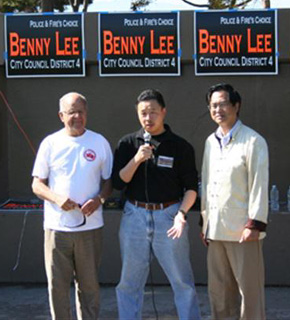
Tony Santos, Benny Lee and Hendy Huang

Benny Lee (center) with former Mayor Tony Santos (left) and supporter Hendy Huang.

Lee’s mailer highlights bad decision-making by Shelia Young and Tony Santos

I am the volunteer campaign manager for  Chris Crow, who is running for San Leandro City Council District 4, so when I received a mailer from his opponent, Benny Lee, I was quite interested in reading it.  I was expecting he’d use the mailer to answer criticisms about his lack of concrete proposals on how to move San Leandro forward.

Instead, his mailer focused on criticizing the City for three poor decisions made in the last decade.  Surprisingly, these were all done while two of his endorsers, Shelia Young and Tony Santos, were Mayor of San Leandro.  Two of his other endorsers, O.B. Badger and Ursula Reed, were in the City Council at the time.  Tony Santos, in particular, has been Benny Lee’s mentor and they are staunch allies.

The first issue Lee brings up is a loan guarantee the City gave to a private company – with Shelia Young’s approval.  The borrowers defaulted, the lender wants the City to pay up, and we may be on the hook for millions of dollars.

Another has to do with a city street apparently under foreclosure.  Lee’s mailer is not clear on the particulars, but it shows the matter going back to  2005, when Shelia Young was Mayor and Badger and Santos were in the City Council.

Finally, the mailer points out the City could have saved millions by refinancing its pension liabilities when interest rates first fell several years ago.  He is right, but both the Young and Santos administration ignored this issue.  It wasn’t until Stephen Cassidy became mayor that the debt was refinanced.

Lee could have pointed out many other bad decisions past City Councils have made, such as having the City pay the employee’s portion of their pensions, engaging in the Faith Fellowship and Albertson’s litigations  (which combined cost the city about $7,000,000) and not handling the sex and race discrimination issues at the Police Department before getting sued.

I agree with Lee’s tacit conclusion that both Tony Santos and Shelia Young, and more recently Reed, appear to have done less than a competent job while in the Council.   But there is no reason to suspect Lee will do any better.  On his mailer he calls himself a “financial analyst” and promises to fix the city’s budget problems, but a quick look at his resume shows that his actual expertise is in IT, with a focus on financial computer systems.   His promise to search through the city budget for savings seems disingenuous when he could have easily done so already. The budget is available for download at the city’s website.

And indeed, Lee has given us a hint of the type of decisions he will make if elected.  For example, he would kick a green-energy company out of town, because he fears the lone wind turbine they want to install will give his wife headaches.  He would ban marijuana dispensaries because a friend became addicted to alcohol as a teen and then died of cirrhosis (yes, I fail to see the connection as well).  He would get rid of RCV purportedly because Chinese Americans are unable to understand how to vote.  And he would not make Police officers have to pay their share of pension contributions.  In return, the Police union has spent more than $7,500 to get him elected.

Now, given that I support Chris Crow, it’s not surprising that I’m unimpressed by Lee.  What is surprising is how unimpressed he seems to be with the people who endorsed him.