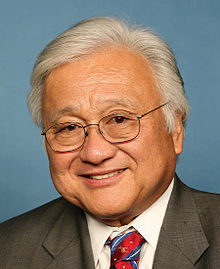
Congressman Mike Honda
The battle for California CD 17 promises to be intense.
Don’t mess with Congressman Mike Honda. He may look soft and cuddly, he may be one of the darlings of the human rights movement, but the man is a force to be reckoned with. Don Corleone could have learned a thing or two from this Silicon Valley congressman.
Mike Honda’s take-no-prisoners approach to politics came into play in the last few weeks, after former Obama administration official Ro Khanna fed rumors that he is considering running for CD 17 in 2014. Khanna originally planned to run for CD 15 and had amassed a $1.2 million war chest towards that end, but he’d given sitting congressman Pete Stark his word that he wouldn’t run against him. Stark refused to retire and after an abysmal re-election campaign, he was defeated by a young, unknown, first-term city councilman, Eric Swalwell. Khanna, apparently, started looking south.
Honda was swift in his response to a possible challenge from Khanna. Within days he announced his endorsement by President Obama and House Minority Leader Nancy Pelosi, soon followed by those of Rep. Steve Israel, Chair of the Democratic Congressional Campaign Committee and Howard Dean, the past Chair of the Democratic National Committee. After the San Jose Mercury News quoted a political science professor in favor of the proposition that a key indicator of Khanna’s chances would be whether the Congressional Asian Pacific American Caucus endorsed Honda or remained neutral, the Chair and 19 members of the Caucus expressed their support for their chairman emeritus.
Khanna’s supporters have attempted to interpret these unusually early endorsements as “signs of [Honda’s] fear and desperation” at the prospect of their guy entering the race. But they are actually a demonstration of Honda’s political acumen. Khanna’s credibility as a candidate is largely based on his fundraising talent and his DC political connections – which his campaign has repeatedly touted. By announcing these endorsements, Honda makes it very clear to would-be Khanna backers that Khanna no longer enjoys the support of the Democratic power structure in Washington. Support him at your own peril.
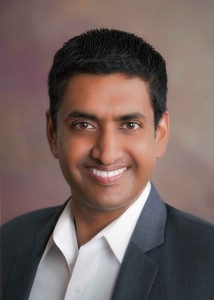
Ro Khanna
Despite his million dollar campaign chest, Ro Khanna will need a lot of support to have a chance to win. Though Khanna supporters have emphasized the fact that redistricting has left Honda with low name recognition and voter loyalty in much of CD 17, Khanna has practically none of either. To overcome this, he will need to build grass roots support from the ground up. He needs volunteers to knock on doors, make phone calls and throw “meet the candidate” events . He also needs to develop a sophisticated media strategy and raise a lot more money. Honda has already started. To make sure he’s available to voters, he has opened satellite offices in Fremont and Newark. He updates his Facebook page often, tweets regularly and even blogson the Patch. He introduces and pushes high-profile legislation, which means his name is often in the press. He is ready for a fight, and has already announced his campaign team for the 2014 election.
Much of Khanna’s support so far has come from the Indian-American community, but it came with the presumption he would run for an open seat in CD 15. Challenging Mike Honda is another matter altogether. As Varun Nikore, past president of the Indian American Leadership Initiative, told India Abroad: ” [Honda] has done an enormous service to the Indian-American community and continues to do so. He’s mentored countless numbers of Indian-American politicians across the county including Ro. Not because he had to, but because Mike Honda so deeply believes in this cause of empowerment for not only Indian Americans, but for all Asian Pacific Americans… We cannot let the ambitions of one trump loyalty here. If we start going after our friends, who will stand with us in future battles to come? Our successes as a community didn’t just come because an Indian American was at the table fighting for our rights and causes. We were helped by leaders in the larger Asian Pacific American community who helped build broad coalitions and represented our community in our issues, like Patsy Mink, Daniel Inouye, Norman Mineta and Mike Honda. We would be nowhere without them.” Echoing the sentiments, newly elected Indian American congressman Ami Bera told the publication that “in recent years, Mike Honda has done more than any member of Congress to help support and grow Asian-American representation in the House of Representatives. Congressman Honda was instrumental in helping me and other Indian-American candidates build out our races, and gain credibility. He has always been there for us, raising funds, providing advice, and being a mentor.” Bera has apparently been trying to dissuade Khanna from challenging Honda, with little success.
While Khanna’s supporters acknowledge that he might have lost the support of the Indian-American community nationwide, they trust they can build on the relationships Khanna has made with Silicon Valley and southern Alameda County South-Asian-Americans. And he’s likely to have at least some success at that. Unlike Honda, whose job, after all, keeps him in DC for much of the year, Khanna actually lives and works in the Bay Area and thus he should be able to spend much more personal time cultivating relationships, in particular with those members of the Indian-American community that have not been politically active. A “meet and greet” that three South-Asian-American supporters are throwing for him in early March has over 50 “going” responses on its Facebook page.
In person, Mr. Khanna comes across as an intelligent, well spoken, well educated and thoughtful young man, and he is sure to impress many who meet him. Each event like this will likely win him supporters who will themselves throw further events to introduce him to more community members. And while “meet and greet” and “coffee with the candidate” events are not meant to be fundraisers, they often become that, which should help his finances.
Khanna can also benefit from the many political splits within the local Indian-American community which will guarantee him the support of at least one faction in Fremont. But he can also take advantage of ethnic/religious splits. For example, he signed on to a letter written by supporters of Gujarati Chief Minster Narendra Modi, asking Mike Honda to withdraw his signature from a letter asking the State Department to continue denying Modi a visa to come to the US. Modi has been denied a visa because of his involvement in the 2002 riots. According to Human Rights Watch, the so-called riots, which resulted in the deaths of up to 2,000 people, mostly Muslims, were “planned in advance and organized with extensive participation of the police and state government officials.” UPDATE Ro Khanna has reached out to clarify that the letter he wrote only asked Honda to meet with Indian-Americans to discuss this issue. He did not ask him to remove his signature. I apologize for the error.
Khanna’s other fundraising success came from his connections in Silicon Valley. He works as an attorney at Wilson Sonsini Goodrich & Rosati, a business and intellectual property law firm headquartered in Palo Alto, and for two years was as a Deputy Assistant Secretary for the Commerce Department, where he got kudos for his work. He has recently published a a well-received book on the future of American manufacturing. Support from Silicon Valley donors, however, is likely to be strategic – and Khanna will have to make a very good case that he has something to offer them that is worth antagonizing Honda, the President and the Democratic party leadership.
Honda, meanwhile, is working hard to take on the mantra of modern manufacturing from Khanna. Two days after President Obama announced on his State of the Union speech that he wanted to establish three more manufacturing innovation hubs in different parts of the country, Honda sent him a letter making a case for why one should be located in his district. The next day, he published an op-ed in the San Jose Mercury News, co-written with Silicon Valley entrepreneur Kevin Surace, on how Congress can revive American manufacturing. The clear message is “you don’t need Khanna, I’m on top of this”. To be fair, this is not a new area of concern for Honda; last July he introduced a bill also aiming to boost domestic manufacturing.
Khanna, for his part, has also been throwing himself into Honda territory. Khanna also had an op-ed in the Feb. 15th issue of the San Jose Mercury News, his on the subject of the growing conflict between China and Japan over the Senkaku/Diaoyu islands. The op-ed was co-written with Peter Stanek and Ignatius Y. Ding, two activists with an organization that seeks reparations from Japan for WWII crimes. In the past, both of them have supported Mike Honda, in particular on his efforts to get justice for comfort women. Khanna’s play for the Chinese-American vote, however, seems clumsy. In the op-ed he argues that China, and not Japan, is America’s most important trade partner and he suggests that the US should not back Japan on this dispute. This stance might gain Khanna some Chinese-American votes, though it seems unlikely that a significant portion of the electorate would vote on a US congressional election based on that particular issue. Moreover, it may prove divisive within the broader Asian-American community and suggest to general voters that Khanna doesn’t have the stomach to stand up to China when needed.
Khanna supporters have been encouraged by Eric Swalwell’s defeat of Pete Stark in CD 15 and emphasize the similarities between the races, namely, the age difference between both candidates and the effects of redistricting. Both are red herrings, however. Pete Stark’s age only became a factor in his campaign because his behavior made voters – and the press – question his mental competency. Even his supporters acknowledged that he was no longer effective. There is no question, however, that Honda is mentally spry and that he is one of the most influential members in Congress; not everyone can call the President and get an immediate endorsement two years before a race (by contrast, Obama only endorsed Stark three weeks before the 2012 primary election).
Redistricting, moreover, does not appear to have hurt Honda. While Stark was left with a district that now includes much wealthier and conservative areas, the demographics of Honda’s new district are not significantly different. Indeed, he won CD 17 with 73.5% of the vote, 5 points more than what he received in his last election in then CD 15.
Eric Swalwell was able to win his election on the strength of the Republican and conservative votes that he openly courted. But he only succeeded at this because there was no Republican candidate in the race (Chris Pareja, a tea partier, ran as an independent). Khanna will not be that lucky. Evelyn Li, who ran against Honda in 2012, seems ready for a rematch. If she’s able to keep her 27.6% of the primary election vote, Khanna will be left having to convince a third of all the people who voted for Honda in 2012, that he is no longer their man. That’s a pretty high bar.
And it’s a bar that Eric Swalwell was not able to pass himself. When everything was said and done, Swalwell was only able to carry roughly 14% of former-Stark voters. Only in those cities that had not previously been represented by Stark, Swalwell was able to gather a third of the vote that had previously gone to the Democratic candidate for Congress. Khanna will have to make those numbers in all the cities in his district, and against an opponent that is willing and able to fight hard.
Can Khanna do it? Perhaps. For one, he might get very, very lucky and be able to uncover some very deep, dark secret from Honda’s past. And, of course, there is always the possibility that Honda may mess up big time, though, given his district, it will have to be something worse than a weiner tweet, bathroom footsie or shirtless photos on Craigslist.
Absent that, instead of running against Mike Honda, Khanna may consider running against Paul Ryan. In other words, Khanna could concentrate on building his own political persona, and hope that it can overshadow Honda’s on the ground. Khanna’s background is in economics, and he has already been seen on national TV news shows talking about manufacturing. If he is able to develop his own economic policy for the country, one that provides a credible, progressive answer to Paul Ryan, he may be able to use the power of the national media to bring even more attention and credibility to himself. Khanna can actually benefit from having been spurned by the Democratic leadership, as this frees him to write a plan focused only on what’s best for the country and the American people. Khanna might also want to hit Honda at his core on the issue of education reform, though he will have to develop a plan that makes sense for his district.
While the road to victory will be long and arduous, Khanna does have an ace in his pocket: the local media. Both the San Jose Mercury News and the San Francisco Chronicle are salivating at the possibility of a Honda-Khanna race (which has even grabbed the attention of the New York Times). Not only have both papers been leaning to the right lately, but a race of this type is sure to generate a lot of copy. Khanna has been developing a good relationship with both papers’ political reporters, so he probably can count on a lot of good press. And if Khanna can do it, and win on the merits of his platform, he will arrive in Washington with the credibility and gravitas of a true leader and not of just a good fundraiser.


 A couple of years ago, the San Leandro Police Department instituted a “coffee with the cops” program. The Police Chief and/or several of her officers would meet with the community to give a general talk on the state of crime in the city and answer questions.