City Council

May 312011
 

The demographics of San Leandro have changed dramatically in the last few years.  According to the 2011 census, just 27% of San Leandrans identify themselves as white, down from 51% in 2000.  In 1970, however, a full 97% of San Leandrans were white.  Africans American today make up almost 12% of the population; in 1970 they were 0.1%.  Those numbers were not happenstance, rather, they were the result of very specific and very successful policies of racial discrimination that kept non-whites, and in particular blacks, from moving into the city.   Originally, non-whites were kept out of town by restrictive covenants.  Once these were ruled unconstitutional, elected officials, the Chamber of Commerce, homeowner associations, apartment owners and realtors all conspired to prevent blacks from renting or buying property in town.  Realtors would not show houses to blacks, owners would not sell them, and anyone who refused to tow the line would feel the pressure from the rest.  Only in the late ’80s did San Leandro start to integrate.

San Leandro’s dirty history as one of the most racist town in America was definitely known to African Americans in nearby communities.  It became known to the rest of the country due to a couple of TV news stories (The Suburban Wall and the Invisible Wall) that showcased the problem.  But as time went on, and new people came to town, San Leandro’s racial history seemed to be forgotten.  It wasn’t until comedian Brian Copeland started his one-man-show “Not A Genuine Black Man”, which deals, in part, about perils he suffered as a black boy who moved into San Leandro in the 70’s, that the issue came back to light.  But not everyone was happy with that.

In 2005, City Manager John Jermanis and Public Library Director David Bohne decided to commission a book on the history of San Leandro.  They hired a young writer to do this, he produced an outline that included a chapter on this unpleasant aspect of San Leandro history.  The writer also proposed to talk to Brian Copeland about his own experiences.  Jermanis and Bohne ordered him to leave that part out of the book; when he refused on ethical grounds, they cancelled the whole book project.   Of course, they did that as quietly as possible.

I found out about the botched history book through an e-mail by Brian Copeland that a friend forwarded.  I set out to find out what had actually happened, and contacted Jermanis, Bohne and several city council members.  Jermanis originally talked to me, but when he realized that he couldn’t make his actions look in any way legitimate, he quickly stopped the conversation.  Bohne, meanwhile, made excuses for months to not accept my calls.  When I finally met him at a public event, he refused to even speak to me.  Jermanis, meanwhile, ordered the then public information officer Jane Crea to come up with a “story” to justify what they had done.  Unfortunately, her story had many holes and contradicted other facts.  What I learned from all of this, was that the racist policies that had driven this city until the 1980’s were alive and well at City Hall and at the Public Library.

I documented some of my conversations at the time on a webpage that I shared my friends and colleagues.  I’m sharing it with the public now because history – even history about the desire to censor history – needs to be known.

Jermanis retired a few years ago as City Manager, but Bohne continues to head the library.  Neither the City Council nor the Library Commission ever held either of them into account for their attempts to censor San Leandro history.

May 132011
 

4/17 Update: As I feared, the City Council has voted to get rid of full minutes. One more step towards hiding what they say and do.

If Mayor Cassidy has his way, as of next Monday the San Leandro City Council will be making it much harder for the public to find out what they’ve been up to.  The City Council is planning to vote to eliminate regular minutes of all public meetings and  replace them with “Action Minutes”. While regular minutes include a summary of what was said and done in City Council and other public meetings, Action Minutes only record the actions taken by the City Council.   Council members (and the public) will no longer have to fear being held accountable for their words: nobody will know about them.

Cassidy argues that there is no need for full minutes of Council meetings because these are now recorded and the audio is made available online.  However, audio is non-searchable.  Unless you know precisely when someone said what, you might end up having to listen to hours and hours of city council meetings looking for the particular statement/position you are interested in hearing.  The audio of the meetings made available by the city is of very low quality, so using current technology it can’t be automatically transcribed.  Cassidy also argues that staff spend an inordinate amount of time composing the minutes of public meetings.  I am sure that is true, but I daresay they will spend just as much time going back and listening to old meeting recordings when the City Council itself needs to refer to old issues.  Why is it that they voted for Red Light Cameras back in 2011?  What other alternatives were provided?  The only way to find out will be for a staff member to listen to hours of audio.  In addition, as important as saving staff time is, it’s even more important to keep local government actions transparent and the public informed.

I think what’s really behind this move to get rid of full minutes is the same thing behind the move to delete City government e-mails: a desire by City Council members and staff to not be held accountable for their words and actions.  They want to be able to flip-flop and say and do inappropriate things with impunity.

If you care about maintaining transparency in local government, please write to the City Council and ask them to vote NO on switching to Action Minutes. You can e-mail them all together by pressing here.

May 072011
 

Hires premier anti-RLUIPA advocate to argue for its unconstitutionality

I was sad, if not surprised, to read that the San Leandro City Council voted 5-2 (with Mayor Cassidy & Councilwoman Cutter in the minority) to appeal the 9th circuit Faith Fellowship decision to the US Supreme Court.   That’s exactly what I predicted Meyers Nave, the City’s law firm, would push the City Council to do.  I was tickled, however, to read that they’ve engaged Cardozo Law Professor Marci A. Hamilton to represent them on this appeal.  Hamilton is not only the country’s most prominent critic of RLUIPA,  and of government accommodation of religion in general, but she’s a woman with a mission:  get the Supreme Court to declare RLUIPA unconstitutional.   San Leandro may just help her accomplish that goal.

The Faith Fellowship case has so far involved rather technical matters: what is the proper standard for “substantial burden” under RLUIPA.  Circuits courts have come to different conclusions as to what this entails, which allows the Supreme Court to take on the case.  However, the US Supreme Court has so far denied all cert petitions on RLUIPA land issues, most recently in January.  This is not surprising, finding a “substantial burden” test that would make the law both meaningful without being abusive in all circumstances is quite difficult, courts have gone back and forth on definitions as new situations arise.  The Supreme Court may find it prudent to wait until the dust is a bit more settled at the circuit court  level before it intervenes.

But I don’t believe that Professor Hamilton has any plans to appeal this case, other than nominally, on the proper definition of “substantial burden”.  Hamilton, indeed, has repeatedly said that RLUIPA allows religious institutions to do anything they want.  She’s suggested the statute be subtitled “A Bill to Permit Religious Landowners to Do Whatever They Want in Residential Neighborhoods and to Subsidize Lawyers for Religious Landowners with an Attorney’s Fee Provision”.   A narrow “substantial burden” definition would not fit neatly with her description of RLUIPA as a “circus“.

Hamilton, I suspect, will use this opportunity to lounge a full front attack on the constitutionality of RLUIPA, most likely on federalist grounds (i.e. that the federal government doesn’t have the right to tell municipalities how to regulate land use).  She’s well suited for the task.  In 1997 she represented the City of Boerne in the landmark Supreme Court case that overturned the Religious Freedom Restoration Act vis a vis state and local governments.  While Congress created RLUIPA mindful of the Boerne case, and every single circuit court that has looked at the constitutionality question has upheld it, Hamilton is hopeful that the more conservative members of the court will side with her.  My guess is that if the Supreme Court does take this case it will do so to tackle the constitutional question.  The fact that Hamilton will be the one arguing the case, may indeed make it more likely that they’ll take it.  The odds are still quite slim, however.

If the Supreme Court does take the case, Hamilton won’t just be facing the able lawyers from the Pacific Justice Institute (PJI).  The US Justice Department will most likely intervene to defend the constitutionality of the law.

Even if the Supreme Court finds that the “strict scrutiny” provisions of RLUIPA are unconstitutional, the Supreme Court (or lower courts, if the Supreme Court remands the case) will still have to consider the question of whether the City of San Leandro violated Faith Fellowship’s constitutional rights to freedom expression and religious exercise and its constitutional and statutory right to equal protection of the laws.  The latter claims come about because San Leandro allows “commercial entertainment” uses in the industrial area but not “assembly” uses.  The 9th circuit didn’t address this issue, but left it open for future litigation.

Personally, I continue to believe that appealing this case to the Supreme Court is a costly mistake.  If the Supreme Court takes the case, it’s very unlikely that it will rule for the city on all grounds without remanding any to a lower court.  If it does remand the case, that would mean further litigation and much more money spent on attorneys’ fees.  We are a poor city that has had to cut libraries, recreational activities and most social services – we can’t afford to be handing money to lawyers for no good reason.

The prudent thing for San Leandro to do is to work to settle this case, preferably in the next 6 months before the Supreme Court either rejects it or takes it on.

Update 5/8/11

I e-mailed Prof. Hamilton and asked her why she took the case.  Here is her answer:

“I took this case, because it meets the typical criteria that interest the Supreme Court: the relevant issues have been percolating for a significant period of time, the courts are split on the proper interpretation of the key terms, and the issues were directly addressed by the appellate court.  It is time for the Court to take up one or more RLUIPA land use issues.

 Also–the Ninth Circuit’s interpretation in this case is an extreme interpretation that unfairly favors religious land owners and, therefore, is a good case to take up to the Supreme Court.”

Marci Hamilton on the Daily Show

Marci A. Hamilton on Flaws of Religious Land Use Law

Apr 282011
 

Are you, like me, unhappy about the idiotic decision the San Leandro City Council made in renewing the contract with Redflex, the red-light camera company, for eight years?  Do you wonder how we got into that whole pensions mess that risks bankrupting the city?  Are you angry that the City pays its law firm over $1 .2Million a year but cut down on swimming pool and library hours and did away with the Cherry Festival and the Christmas Tree lighting?  Well, you have no one but yourself to blame.  YOU are the one who voted for this Council.  It’s YOUR fault.

Ok, that’s sort of unfair.  I voted for them too.  Truth we told, we didn’t have a choice.  Most of members of the City Council ran unopposed or faced opponents with even fewer qualifications than themselves.  We voted, in many instances,  for the lesser of two evils – but a lesser evil is still an evil.

Ask anyone who follows San Leandro city politics closely and they’ll tell you the biggest problem is finding competent candidates.  Running for office (if you get a serious, even if incompetent, opponent) can be expensive and time consuming, there are few perks to being a Council Member and, if you take your role seriously, it’s a lot of work.   Unless you need an extra $1200 a month or have political aspirations, the only reason to do it is to help your community – and lets be honest, most of us are not that civic minded.  But without that civic mindedness we end up where we are.  So really, take on the challenge – run for office!

The next City Council elections will be in November 2012.   The seat for District 4, which mostly includes Washington Manor, will be up for grabs as Starosciak will be termed out.  Prola (District 6, the Marina) and Reed (District 2, southeast San Leandro) will face re-election.   To run for a city council seat you must live within the borders of the district you are running for (look at the map) – so if you don’t live in those areas you’ll have to wait until 2014 (when Gregory from District 1 and Souza from District 3 will be termed out, Cutter from District 5 will probably run for re-election).

I’ll be honest with you: running for City Council is not going to be easy.  In District 6, Jim Prola is virtually indestructible.  Not only does he come with all the strength of organized labor behind him, but he’s a tireless campaigner.  He’ll walk every street of San Leandro during the campaign – twice – and will have fun doing it.   Ursula Reed, on the other hand, is more vulnerable.  While defeating an incumbent in San Leandro is very hard (Michael Gregory, for example, easily got 65% of the votes in the last election), it’s not impossible as Cassidy’s defeat over incumbent Mayor Santos showed.  Reed ran a very good campaign in 2008, but it was against an opponent who relied on her name recognition alone and did not campaign.   Reed received a lot of support from part of the progressive community in 2008 that may no longer be there in 2012.  I think that a progressive candidate that could create a good grassroot campaign would be able to defeat her.

The District 4 Washington Manor seat, however, is wide open.  There have been whispers about a couple of people running for that seat but nobody has announced as of yet and none of the potential candidates are well know.  If you live in the Manor, you are smart, competent, willing to do a lot of work and make sound decisions – and preferably (for me) progressive, you should seriously consider running.

The Alameda County Democratic Party will be holding a “running for office” workshop on May 14, 2011, 9 a.m. – 1 p.m at  UFCW Local 5 in Hayward.  This would be a great place for you to start if you are intrigued by the notion of a 2012 City Council run.  For more information e-mail  info@acdems.org or call 510.537.6390.

Apr 162011
 

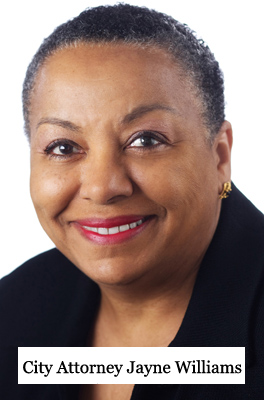
San Leandro City Attorney Jayne WilliamsUnlike many cities, San Leandro does not have a full time City Attorney of its own.  Instead, it contracts with Meyers Nave, one of the most important municipal law firms in the state, for legal advice and representation.  Jayne Williams, one of Meyers Nave’s principals, functions as San Leandro’s City attorney – but other members of the firm also do work for the city.  Unfortunately, the quality of the legal advice that San Leandro is getting from Meyers Nave seems to be quite poor. San Leandro is currently facing a multi-million dollar settlement/judgement in the Faith Fellowship case and is opening itself up to litigation on several fronts.  Meyers Nave benefits from the poor legal advice it provides to the city, charging attorney’s fees to represent it in lawsuits that arise when the city follows its advice.

As mentioned above, the most egregious example of this conflict of interest is the Faith Fellowship case.  Here, a local church that had undergone dramatic growth tried to move to a building large enough to accommodate its congregation.  The only property they could find that would work for them was zoned industrial, and the City Council refused to let them use that property as a church.  Faith Fellowship sued under the Religious Land Use and Institutionalized Persons Act (RLUIPA), and the 9th circuit recently ruled that the city had no compelling interest in denying them that use, and remanded the case for trial on other issues.  A close examination of the case leads me to believe that the city is not likely to prevail and will likely have to pay several million dollars in damages to the church.  The city has already spent $500,000 on legal costs alone, and will be on the hook for Faith Fellowship’s attorneys fees as well.

Meyers Nave’s behavior on this case has been outrageous.  First, it failed to warn the city about its legal liabilities under RLUIPA if it denied the church’s rezoning application.  While it did warn the City Council that they could get sued, it did not explain what the potential damages of the lawsuit might be or what the likelihood of the church succeeding was.  Once the City was sued, rather than advising the City to hire a law firm that specialized in RLUIPA and/or first amendment litigation, Meyers Nave had its own attorneys represent the city.  Meyers Nave made a lot of money on attorneys fees by doing so, but its attorneys were unable to produce coherent or convincing arguments. Attorney Deborah Fox, in particular, made a fool of herself during oral arguments before the 9th circuit – she was clearly unprepared and was unable to answer the judge’s questions with any credibility or coherence.  The rehearing petition filed after the 9th circuit unanimously ruled against the city is so poorly written and so disrespectful of both Faith Fellowship and the 9th Circuit appeals panel, that the city of San Leandro should be ashamed to be associated with it. Still, as inadvisable as filing that rehearing petition was, it does generate additional legal fees for Meyers Nave.

But the firm’s inadequate legal advice goes beyond the Faith Fellowship case.  In 2005, the City of San Leandro entered into an agreement with Redflex for the installation of six red light cameras in the city.  This agreement included a “cost neutrality” clause, which provided that the city and Redflex would share in the revenue from the red light camera tickets.  This cost neutrality provision, however, is explicitly in violation of California law and San Leandrans have been able to have their tickets dismissed on these grounds.  Moreover, there is currently a class action lawsuit on those exact grounds making its way through the courts that, if successful, might force the city in question to provide a refund to everyone who received a red light citation during that contract.   Meyers Nave does not appeared to have warned the city about the illegality of that contract provision and of the potential legal and financial consequences of having it in place – thus, once again, subjecting the city to needless legal risk.

At its next meeting, the City of San Leandro will likely extend its contract with Redflex.  The cost neutrality clause is gone (fortunately), but it remains questionable whether red light camera tickets are legal.  The City Attorney has not, once again, explained to City Council members what the legal issues related to red light cameras are and what the city’s legal risk is in signing this contract.

The same can be said about a new policy that the City is considering to automatically delete all staff and council e-mails.  This policy would violate the California Public Records Act, and would subject the city to litigation.  Has the City Attorney explained these risks (and potential costs) to the City Council?

I suspect that this is the proverbial tip of the iceberg.

My suspicion is that San Leandro would do better if it hired its own full-time city attorney, someone who was able to give it objective, realistic advice and had no incentive to get the city into costly litigation.

April 17th Update

In response to a question in the comments, I’m updating this note with some information about the financial arrangements between Meyers Nave and the City of San Leandro.  In 2008, the city entered into an amended agreement with Meyers Nave, for the firm to provide legal services indefinitely.  Until then, the city legal costs averaged about $900,000 a year, though they were over $1.2 MILLION for the 2007-08 fiscal year.  Legal costs under the amended contract are higher, and I will publish the actual expenditures when I get the numbers.  Under this new contract, Meyers Nave gets paid:

-around $28K a month for basic City Attorney services

-$210/hour for attorney services and $110/hour for paralegal services for non-basic services

-travel expenses

-5% of their fees for administrative costs

The amounts are to increase annually based on the consumer tax index, plus Meyers Nave may ask for additional compensation as it sees fit.

For more recent updates of what Jayne Williams and/or Meyers Nave has been up to in San Leandro, check out the Meyers Nave tag.